
Are Industrial Parts Worth It for Landscaping Fleets?
Last Updated: November 5, 2026
Quick Summary
Buying industrial parts is worth it for landscaping fleets when you stock routine wear items like belts, bearings, and blades and order slow-moving, model-specific parts on demand. Match every part by model and spec number before ordering, and use a reorder point to decide when bulk buying pays off.
- Parts costs rose 3.7% year over year in the fourth quarter of 2025, per Decisiv data.
- Stock two belts and bearings per machine and one spare blade set per machine.
- Confirm fitment by reading the model and spec number, then cross-referencing the OEM part number.
- Calculate reorder point as average daily usage times lead time, plus a safety stock buffer.
- Score suppliers on fitment support and delivery speed before comparing shelf prices.
Table of Contents
- Why Parts Costs Are Squeezing Landscaping Fleet Budgets
- Landscaping Equipment Replacement Parts: The Categories That Fail Most
- How to Identify the Right Part Before You Order
- Landscaping Fleet Maintenance: What to Stock and What to Order on Demand
- Bulk Landscape Tools and Supplies: When Volume Buying Pays Off
- How to Evaluate Industrial Equipment Parts Suppliers
- Repair or Replace? Running the Lifecycle Math
- Check Out the 4J Total Supply Parts Catalog
- Frequently Asked Questions
Why Parts Costs Are Squeezing Landscaping Fleet Budgets
Parts costs rose 3.7% year over year in the fourth quarter of 2025, according to Decisiv data reported by TruckingInfo, and that increase lands directly on the maintenance line of every landscaping fleet. Crews need more machines running, and each breakdown can cost a full day of billable work. The U.S. landscaping industry grew at an average of 6.5% per year between 2020 and 2025, per the National Association of Landscape Professionals, so fleets are expanding while parts get more expensive. Buying industrial parts well is now a margin decision, not a chore. Below, we break down which parts fail most, how to identify the right one before you order, and when bulk buying actually pays off.
Landscaping Equipment Replacement Parts: The Categories That Fail Most
Landscaping equipment replacement parts fail in predictable patterns, and knowing those patterns is the difference between a planned repair and a lost day. The two categories that account for most unplanned downtime on professional crews are drivetrain components and cutting components. Both wear from the same enemies: grit, moisture, and hours.
Belts, Bearings, and Bushings
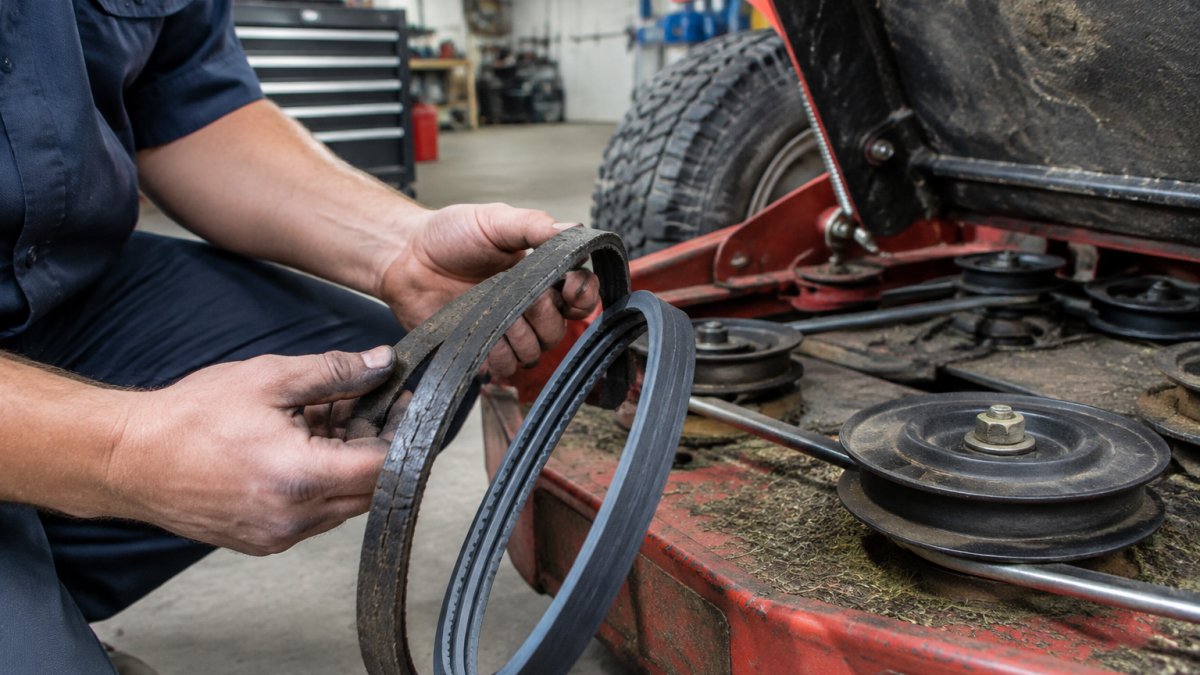
Belts, bearings, and bushings are the first parts to fail on turf equipment because they carry constant load in dirty conditions. A stretched belt slips, a dry bearing howls, and a worn bushing lets a shaft wander until something breaks. Stock the common sizes before the season starts. A standard V-belt like the V-Belt Size 5L570 B54 at $13.99 cross-references Z-Spray drive belt part 80413, and a bearing with a lock collar such as the Ryan 545786 at $29.99 is listed for tine group #5 and drum group #8. Watch out: a belt that keeps failing usually points to a misaligned pulley or a seized bearing, so replace both together.
Blades, Edger Blades, and Cutting Components
Cutting components wear faster than any other category because they meet grit and stone at full speed. Dull blades tear turf instead of slicing it, which stresses the engine and leaves a ragged cut that customers notice. Edger blades take the worst abuse, hitting concrete and curb edges on every pass. Keep at least one spare set per machine and inspect edges weekly. If you run dedicated edging crews, browse the Stens replacement edger blade for Echo 375 and 382 units so a chipped blade never idles a crew.

How to Identify the Right Part Before You Order
The right part is the one that matches your engine or equipment model and spec number exactly, not the one that looks similar. Most ordering mistakes happen because a buyer matches by appearance or by machine name alone. Manufacturers change specs mid-production, so two machines that look identical can take different components.
Use this four-step check before every order:
- Read the model and spec number off the engine plate or equipment tag, not from memory
- Find the OEM part number in the parts manual for that spec
- Cross-reference the OEM number against the replacement listing
- Confirm fitment notes, including fuel and ethanol restrictions
A common mistake is ordering a carburetor kit for a "GX240" without checking whether the engine is a standard or cyclone version.
Landscaping Fleet Maintenance: What to Stock and What to Order on Demand
Landscaping fleet maintenance splits cleanly into two lists: parts you stock because failure is routine, and parts you order on demand because failure is rare. Stocking the wrong items ties up cash; stocking nothing turns a two-hour repair into a two-day wait.
| Part Type | Stock Level | Order on Demand | Why |
|---|---|---|---|
| Belts and bearings | 2 per machine | No | Routine wear, cheap to hold |
| Blades and edger blades | 1 spare set per machine | No | High-wear, fast swap |
| Filters, plugs, oil | Full season | No | Consumed on a fixed schedule |
| Carburetor and starter assemblies | 1 shared spare | Beyond that | Slow-moving, model-specific |
| Water drums, wheels, drums | No | Yes | Rare failure, bulky to store |
The Honda GX240-GX270 engine maintenance kit at $32.25 includes oil, a spark plug, and an air filter for non-Cyclone 8 and 9 HP engines. For smaller 3.5 and 4 HP engines, the Honda GX110/GX120 maintenance kit runs $22.99.

Bulk Landscape Tools and Supplies: When Volume Buying Pays Off
Bulk landscape tools and supplies pay off when consumption is predictable and storage is cheap. Filters, plugs, belts, and blades all fit that test: you know roughly how many you burn per season, and they do not expire.
Start with a reorder point for every stocked item. The formula is simple: reorder point equals average daily usage multiplied by lead time in days, plus a safety stock buffer.
Three signals that volume buying is right for you:
- You replace the same part on three or more machines each season
- The part is small, light, and easy to store
- Your fleet mix is stable and unlikely to change mid-season
If any of those is missing, buy to a reorder point instead. The trade-off is carrying cost versus downtime cost.
Seasonal demand changes the math. Pre-season is the time to build stock on blades, belts, and filters, because usage spikes when crews run full schedules and suppliers get backed up. Off-season is the time to draw down slow movers and re-score suppliers before the next ramp.
Trimmer Rack for Enclosed Trailer LT12 →
A trimmer rack like the LT12 enclosed trailer rack at $169.99 is a one-time purchase that protects trimmers from damage in transit, which is a volume decision of a different kind: buy once, stop replacing. Tune-up kits make the stock decision easy, too.
How to Evaluate Industrial Equipment Parts Suppliers
Industrial equipment parts suppliers separate into two groups: catalog sites that ship whatever you click, and suppliers that help you confirm fitment before the box leaves the dock. The second group costs less over a season, because a wrong part is never cheap even when the price is low. The gap most buying guides leave open is how to compare suppliers on paper before you open an account.
Score each candidate supplier on a 1-5 scale across six weighted criteria, then total the weighted score. Weights below reflect what typically drives cost for landscaping fleets, where a down machine costs billable crew hours.
| Criterion | Weight | What a 5 looks like | What a 1 looks like |
|---|---|---|---|
| Fitment support | 25% | Confirms OEM cross-reference by model and spec number before order | Ships whatever you click, no fitment help |
| Stock depth | 20% | Carries slow-moving assemblies, not just fast movers | Fast movers only; special-orders everything else |
| Breadth | 15% | One supplier covers belts, bearings, pumps, and spray components | You must split orders across three vendors |
| Delivery speed | 20% | Real ship time quoted when a machine is down | Vague lead times, no expedite option |
| Returns and terms | 10% | Clear return window and restocking policy on wrong-fit parts | No returns on special orders |
| Account terms | 10% | Net terms, bulk pricing tiers, dedicated rep | Prepay only, no volume pricing |
Multiply each score by its weight and add the results.
Watch out: a low unit price on a slow-moving, model-specific part can hide a long lead time and a no-return policy, so score returns and delivery before you compare shelf prices.
Purchasing terms deserve the same scrutiny as the parts themselves. A supplier that carries repair kits and bearings across categories, like our Pumptec repair kits and bearings selection, is worth more than a slightly cheaper site that makes you hunt across three vendors.
Run the scorecard once per season, not once per order. Fleet mixes change, suppliers change stock depth, and a supplier that scored well last spring may have narrowed its catalog by fall.
Repair or Replace? Running the Lifecycle Math
Repair wins when the part cost stays well under the replacement value of the machine and the repair restores full function. Replace when repeated failures on the same machine start costing more in downtime than a new unit costs in payments.
Run the math on three numbers: the part cost, the labor hours, and the revenue lost per down day. A $13.99 belt that takes one hour to fit is an easy repair. A $156.63 water drum on an aerator is still cheap against a new unit. But three failures in one month on the same machine signals a deeper problem, and that is when replacement starts to win.
Check Out the 4J Total Supply Parts Catalog
Keeping a landscaping fleet running comes down to buying the right industrial parts before a machine goes down, not after. At 4J Total Supply, we stock the belts, bearings, blades, tune-up kits, and spray components that fail most often, and our team helps you confirm fitment before you order. You get a large inventory of industrial parts and equipment, expert guidance in selecting the right parts, and fast service and delivery. Check out the 4J Total Supply parts catalog and get the exact components your crews need to stay in the field.
Frequently Asked Questions
Where can landscaping businesses buy replacement equipment parts?
Commercial crews typically buy from three channels: dealer networks tied to the equipment brand, general industrial parts distributors, and specialty suppliers that stock turf and engine components. The third option often carries cross-referenced aftermarket parts, such as a Stens carburetor kit that replaces a Honda OEM number. Whichever channel you choose, confirm the supplier lists the OEM number the part replaces and can verify fitment by engine model and spec, since the same engine family can use different components across applications.
What parts should landscaping fleet managers keep in stock?
Stock the parts that stop a crew fastest and cost least to hold: belts, bearings and bushings, filters, spark plugs, and blades. A V-belt like the 5L570 B54 at $13.99 is cheap insurance against a drive failure mid-route. Add a maintenance kit for each common engine family, such as the Honda GX240-GX270 kit at $32.25, so routine service does not wait on an order. Keep high-failure items on the shelf and order larger components, like a water drum or wheel, only when a machine is down.
How can a landscaping business reduce equipment downtime?
Downtime usually comes from two things: not having the part and not knowing which part to order. Fix both by recording engine model and spec numbers for every machine, keeping a fitment sheet per unit, and stocking the fast-moving wear items. Parts costs keep climbing, so ordering the wrong part is an expensive mistake twice over. A short call to a supplier that cross-references OEM numbers can prevent it.
Are aftermarket parts suitable for commercial landscaping equipment?
Aftermarket parts work well when they are cross-referenced to a specific OEM number and the supplier states the fitment clearly. Stens replacement kits, for example, list the Honda numbers they replace, such as 16100-ZE2-W71 for the GX240 carburetor service kit. Check two things before buying: that the OEM number matches your engine, and that any limitation is disclosed, like ethanol compatibility above 10%. For high-stress components, compare the specification rather than the price alone.
How do landscaping companies compare equipment parts suppliers?
Compare on four points: whether the supplier lists OEM cross-reference numbers, how fast they ship, whether they stock hard-to-find parts for older machines, and what the return policy covers if a part does not fit. Breadth matters too if you run mixed equipment. A supplier that stocks engine kits, belts, bearings, and trailer accessories from one warehouse saves you juggling vendors. Ask directly how they handle a wrong-part order before you place a large one.
