

How to Identify Correct Equipment Parts: A 2026 Guide
Table of Contents
- Start With the Identification Plate: Equipment Model and Serial Number Lookup
- How to Find Equipment Part Numbers in Manuals and Parts Catalogs
- How to Check Replacement Part Compatibility Before You Buy
- How to Identify OEM Parts vs. Aftermarket Replacements
- Verify Authenticity With Barcode Scans, Labels, and Markings
- Common Mistakes That Lead to Ordering the Wrong Equipment Parts
- Frequently Asked Questions
Last Updated: October 12, 2026
Start With the Identification Plate: Equipment Model and Serial Number Lookup
The fastest way to identify correct equipment parts is to read the machine's identification plate first.
At 4J Total Supply, we field calls every day from crews who ordered the wrong filter or carburetor because they skipped this step.
Equipment identification starts with three numbers you should always write down:
- Make and model (for example, Honda GX240)
- Serial number or spec code
- Engine or component code stamped on the unit
OSHA guidance on machine guarding and equipment inspection notes that clear equipment records support safer maintenance. The same records make parts ordering faster.

A Repeatable Identification Workflow
Most wrong orders happen because someone reads half the plate and stops. Run this sequence every time, in order, and you'll cut returns sharply:
- Photograph the plate. Take one wide shot showing the plate's location on the machine and one tight shot of the stamped characters. Flashlight at an angle, not straight on, raking light makes stamped digits readable.
- Record every line, not just the model. Plates often carry make, model, serial number, spec or build code, and sometimes a family or PIN. Copy all of them.
- Note the engine or component code separately. On small engines, the block stamp is its own identifier and can differ from the machine plate.
- Write the hour meter reading and the machine's year of service. Both help a supplier narrow breakpoints when the plate is ambiguous.
- Confirm the numbers back to the supplier before ordering. Read them aloud or paste the photo into the order notes.
This five-step capture is the difference between a one-call order and a three-call return.
Where to Find the Plate on Common Machines
Most identification plates sit in one of a few predictable spots. On tractors and mowers, check the frame near the engine or under the seat. On vacuum trucks and sewer jetters, look on the pump housing or the driver-side door jamb.
If you can't find it, grab a flashlight and a rag. Grease and dirt hide plates constantly. A plastic scraper and a little solvent will lift paint and grime without erasing the stamp.
What to Do When the Plate Is Missing, Damaged, or Unreadable
A missing plate isn't a dead end. Work through these fallbacks in order, each one narrows the part list further:
- Engine or component stamp. Small engines like the Honda GX series carry their own stamped codes on the block. Those codes tell you the spec, which narrows the part list fast.
- Secondary tags and decals. Many machines carry a second tag on the frame, a dealer-installed sticker, or a paint-code decal that ties back to a build run.
- Owner's manual and service records. The manual that shipped with the machine usually lists the model and spec on the cover page. Service invoices often record the serial number the technician wrote down.
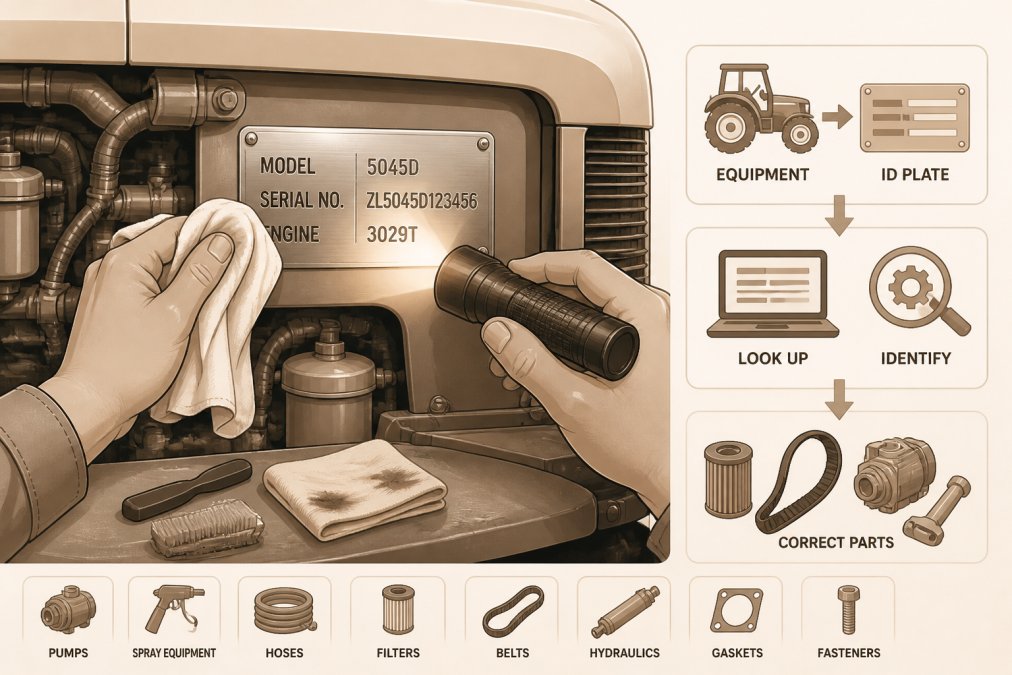
How to Find Equipment Part Numbers in Manuals and Parts Catalogs
Part numbers live in three places: the equipment manual, the manufacturer's parts catalog, and the part itself. The manual is your first stop.
When the manual is missing, use the model and serial number to pull the right catalog. Most manufacturers publish parts diagrams by model year.
How to find equipment part numbers reliably:
- Locate the exploded diagram for your assembly
- Find the item number on the drawing
- Cross-reference it to the parts list
- Write down the full part number, including any suffix
That suffix often signals a revision. Ignore it and you may order an outdated version.
How to Check Replacement Part Compatibility Before You Buy
Compatibility comes down to three checks: fitment, spec, and serial range. Get all three right and the part drops in. Miss one and you're shipping it back.
How to check replacement part compatibility before you commit:
- Confirm the part number matches your model and spec
- Check the serial number range the part covers
- Compare key measurements against the old part
- Verify thread size, hose diameter, and mounting pattern
Take the Honda GX240 8 HP Carburetor Service Kit from Stens. It replaces OEM number 16100-ZE2-W71 and fits most standard and cyclone GX240 engines. The listing is clear: verify the OEM part number by engine model and spec, because it does not fit all applications.

That's the pattern to follow for every part.
Serial-Number and Model-Year Breakpoints
Two machines with the same model name can take different parts. Manufacturers revise components mid-run, and the serial number is how the catalog splits them.
A common pattern is a mid-year change to a filter housing, a pump seal, or a carburetor jet. The old and new parts look nearly identical on the shelf but won't interchange. If your serial number falls on the boundary, call the supplier and read the number back to them.
Part-Specific Fitment Checks and Measurements
Measure before you order. Grab calipers or a tape and check the critical dimensions. The table below covers the checks that catch the most wrong orders:
Honda GX240 8 HP Carburetor Service Kit; Stens 785-689 →
| Part Type | What to Measure | Why It Matters |
|---|---|---|
| Filters | Height, outer diameter, inner seal diameter, seal type (O-ring vs. gasket), thread size | A filter that looks right but seals wrong will leak or bypass |
| Carburetors | Mounting bolt spacing, bore size, fuel inlet size, throttle linkage type | Wrong bore runs lean or rich; wrong linkage won't connect |
| Hydraulic pumps | Shaft diameter, keyway size, spline count, port thread (SAE vs. metric) | Wrong shaft won't couple; wrong port thread strips |
| Belts and hoses | Length, width, cross-section, inner diameter, working pressure rating | Wrong rating fails under load |
| Electrical parts | Voltage, amperage, connector pin count, terminal shape | Wrong voltage burns the part; wrong connector won't seat |
| Bearings and seals | Bore, outer diameter, width, seal material | Wrong material fails in heat or chemical exposure |
A filter that looks right but seals wrong will leak. A pump with the wrong shaft won't turn. Measurements catch these problems before you pay.
Safety-Critical Parts and Installation Verification
Some parts carry more risk than others. Brake components, steering linkages, lifting hardware, pressure-relief valves, and fuel-system parts on enclosed equipment can cause injury or fire if they fail.
After installation, verify before returning the machine to service: check for leaks under pressure, confirm torque on fasteners, cycle the function through its full range, and re-check the part number against the work order.
How to Identify OEM Parts vs. Aftermarket Replacements
OEM parts are made or branded by the equipment manufacturer. Aftermarket parts are made by other companies to fit the same application.
How to identify OEM parts versus aftermarket options:
- OEM parts carry the manufacturer's name and logo on the box
- OEM part numbers match the manual exactly
- Aftermarket parts list the OEM number they replace
- Aftermarket brands often cost less and perform the same
Take the ExMark 109-4180 Hydraulic Filter Replacement from Stens. It replaces OEM number 109-4180 and cross-references dozens of other brands, from Bobcat to Toro.

What most guides miss is that aftermarket quality varies wildly. A cheap filter may use thinner media and fail early.
Verify Authenticity With Barcode Scans, Labels, and Markings
Counterfeit and mislabeled parts are a real problem in industrial supply. A few quick checks protect your equipment.
Scan the barcode or QR code on the box. Many manufacturers link that code to a verification page. It confirms the part is genuine and shows the correct application.
Then inspect the part itself:
- Look for clean, sharp markings, not smudged stamps
- Check that the label matches the part number you ordered
- Confirm the brand name and logo are correct
- Weigh it against the old part if you can
A part that feels too light or has sloppy markings is a warning sign. Real parts have consistent quality.
Common Mistakes That Lead to Ordering the Wrong Equipment Parts
Most wrong orders trace back to a handful of mistakes. Avoid these and your hit rate climbs fast.
The top mistakes we see:
- Ordering by machine name only, not the full model and spec
- Ignoring serial number breakpoints between model years
- Skipping measurements on filters, fittings, and shafts
- Trusting a photo instead of the part number
That last one matters. Many carburetor kits, including the GX240 and GX160 service kits, are not compatible with fuel blends above 10% ethanol.
A common mistake is ordering from a listing that shows a generic photo. The photo may not match the actual part.
Frequently Asked Questions
How can I tell if a part is OEM?
Look for the manufacturer's name, logo, or part number stamped or printed on the part itself or its packaging. OEM parts carry the original equipment manufacturer's branding and match the part number listed in your equipment manual. Aftermarket parts often use a different numbering system, such as a Stens number. If the part number on the label matches the OEM number in your parts catalog, it is genuine. Verify by cross-referencing the number with the manufacturer or a trusted supplier.
What information should I provide when ordering a replacement part?
Give the supplier your equipment's make, model, and serial number, plus the OEM part number from your manual or parts catalog. Include the engine model and spec if the part is engine-related, since the same engine family can use different components. A photo of the identification plate and the old part helps. Supplying all of this at once lets the supplier match the correct equipment parts on the first try and reduces the chance of a return.
How do I know whether a replacement part is compatible with my equipment?
Check the part's listed fitment against your machine's model and serial number range, not just the make. Manufacturers change components mid-production, so a part that fits a 2018 model may not fit a 2021. Compare key measurements like mounting hole spacing, shaft diameter, and thread size. If the listing says 'verify OEM part number by referring to engine model and spec,' do that before ordering. When in doubt, ask the supplier to confirm fitment.
Where can I find the model and serial number on equipment?
Look for a metal identification plate or sticker on the frame, engine, or transmission housing. On tractors and mowers, check near the steering column, under the seat, or on the engine block. On pumps and sprayers, the plate is often on the pump housing or motor casing. If the plate is damaged or missing, check the equipment manual, service records, or contact the manufacturer with a photo of the machine to trace the model and serial number.
Equipment downtime costs money every hour a machine sits idle. The right part, ordered once, keeps your crew moving. At 4J Total Supply, we carry a large inventory of industrial parts and equipment, from Honda carburetor kits to hydraulic filters, and our team helps you match the exact component to your machine. We offer expert guidance, exclusive pricing, and fast service and delivery. Check out our catalog and get the right part the first time.