

Troubleshooting Common Soft Wash Pump Failures
Table of Contents
- Start With a Symptom-to-Cause Diagnostic Flowchart
- Soft Wash Pump Not Pumping: Diagnosing No Flow and Low Flow
- How to Prime a Soft Wash Pump and Fix Lost Prime
- Soft Wash Pump Losing Pressure: Pulsing, Surging, and Seal Damage
- Electrical and Motor Checks: When the Pump Runs but Does Not Move Liquid
- Soft Wash Pump Maintenance: Inspection Intervals and Preventive Checks
- Repair, Replace, or Stop Operating: Making the Call
- Frequently Asked Questions
Last Updated: October 18, 2026
Start With a Symptom-to-Cause Diagnostic Flowchart
A soft wash pump failure almost always traces back to one of four things: air getting in, a blockage, a worn seal, or an electrical fault. This guide from 4J Total Supply troubleshoots in the order that saves the most time, starting with the cheapest checks.
Here is the diagnostic path we recommend. Work top to bottom and stop at the first symptom that matches:
- No flow at all? Check water supply, then prime, then hunt for air leaks.
- Low flow but the pump runs? Inspect the strainer and suction hose.
- Pulsing or surging? Look at the suction line, then the seals.
- Pressure drops after running a while? Test chemical compatibility and seal condition.
- Motor bogs or stalls? Move to electrical and wiring checks.
That order matters. Most people jump straight to the pump head when the real culprit sits three feet away in the water supply.
Soft Wash Pump Not Pumping: Diagnosing No Flow and Low Flow
When a soft wash pump is not pumping, the cause is usually air ingress on the suction side, a collapsed hose, or a clogged strainer, not a failed pump. Start at the water source and work toward the discharge.
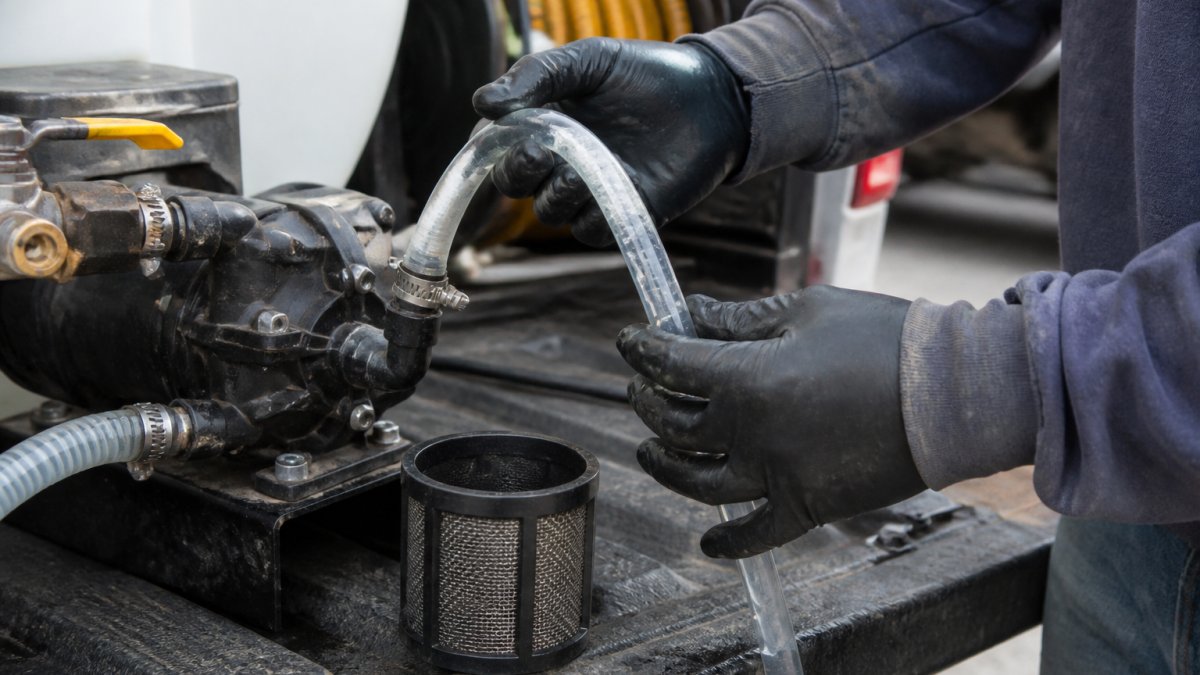
Air Leaks and Air Ingress on the Suction Side
Air leaks are the number one cause of a pump that runs but moves no liquid. A diaphragm pump pulls hard on the suction side, so even a pinhole breaks prime.

Check these spots in order:
- Hose clamps that are loose or corroded
- Cracked fittings and worn O-rings
- A suction hose with a pinhole or split
Tighten every clamp, then reseal threaded joints. If the problem persists, swap in a known-good suction hose to isolate the fault.
Collapsing Suction Hose and Clogged Strainers
A suction hose that collapses under vacuum starves the pump: it flattens and flow pulses or stops. Use a non-collapsing hose rated for suction service, not a standard discharge hose.
Clogged strainers cause the same symptom. Pull the strainer, rinse it, and inspect for debris; a partial block shows up as low flow that worsens as the job goes on.
How to Prime a Soft Wash Pump and Fix Lost Prime
To prime a soft wash pump, fill the pump head and suction line with water before starting, then confirm it holds prime. A pump that loses prime repeatedly has an air leak, not a priming problem.
Follow these steps:
- Fill the tank and confirm the outlet valve is open.
- Disconnect the discharge line briefly to let trapped air escape.
- Pour water into the pump inlet until it overflows.
- Start the pump at low throttle and watch for steady flow.
- Reconnect the discharge and bring the throttle up slowly.
If the pump primes and then loses it within minutes, go back to the air-leak checklist. Flooded suction, where the tank sits above the pump inlet, makes priming far easier and is worth setting up on any struggling rig.
Soft Wash Pump Losing Pressure: Pulsing, Surging, and Seal Damage
A soft wash pump losing pressure usually points to worn seals, a damaged diaphragm, or air still entering the line. Pulsing and surging are early warning signs, inspect rather than live with them.
Common causes of inconsistent output:
- Air in the suction line
- A worn or stuck check valve
- A failing diaphragm
Inspect the check valves first. Debris caught in a valve seat causes surging that mimics a bad seal.
Chemical Compatibility and Pump Seal Damage
Soft wash chemicals are hard on seals. Sodium hypochlorite and other aggressive solutions attack incompatible seal materials, showing up as leaks, pressure loss, and eventually a failed pump.
Match your seal and diaphragm materials to the chemical you run. If you switch chemicals, flush thoroughly with clean water afterward, and never leave a strong solution sitting in the pump between jobs.
When seals do fail, rebuild rather than replace. For Udor KAPPA pumps, the KAPPA-33/43/53 Diaphragm Kit at $86.75 includes three Desmopan pistons and six O-rings, and the 8700.26 KAPPA-55 Diaphragm Repair Kit at $111.99 covers the KAPPA-55 with its accumulator diaphragm.


Electrical and Motor Checks: When the Pump Runs but Does Not Move Liquid
Electrical faults on a soft wash rig fall into two buckets: the motor will not turn, or it turns but bogs down under load. The checks below run from least to most invasive. Use a digital multimeter rated for at least 600V and follow the manufacturer's wiring diagram before probing anything.
Safe Isolation Before You Test
- Shut off the pump at the switch and disconnect the negative battery cable.
- Confirm zero voltage at the motor terminals with the meter before touching wiring.
- Disconnect the pump from the battery bank if the rig uses a dedicated pump battery.
- Tag the circuit so no one reconnects it while you are working.
Never test continuity on a live circuit. A resistance check on an energized pump can damage the meter and create a shock hazard.
Voltage and Current Checks That Actually Diagnose the Fault
| Check | How to Measure | What a Bad Reading Means |
|---|---|---|
| Resting battery voltage | Meter across battery terminals, pump off | Below about 12.4V on a 12V system suggests a weak or discharged battery |
| Voltage at motor terminals, pump off | Meter across motor + and - | More than about 0.5V lower than battery voltage points to wiring, switch, or connection resistance |
| Voltage at motor terminals, pump running | Meter across motor + and - | A drop of more than about 1V under load signals undersized wiring, corroded terminals, or a failing battery |
| Current draw | Clamp meter around the positive feed | Compare to the motor nameplate rating; a draw well above rating suggests a mechanical bind or failing motor |
| Ground continuity | Meter from motor frame to battery negative | More than about 1 ohm indicates a corroded or loose ground |
A common pattern is a pump that spins freely on the bench but bogs on the truck: voltage is fine at rest but sags under load, pointing to the feed wiring, switch, or battery rather than the pump itself.
KAPPA-33/43/53 Diaphragm Kit p/n: 8700.45 →
Motor Runs but No Liquid Moves
If the motor spins at normal speed and current draw is within nameplate range, the fault is hydraulic or mechanical, not electrical. Stop testing the electrical side and move to the suction and discharge checks in the no-flow section; chasing wiring on a hydraulically blocked pump wastes time and can overheat the motor.
Motor Bogs, Stalls, or Overheats
Bogging under load has three common causes on a soft wash rig:
- Restricted discharge. A clogged nozzle, closed valve, or kinked discharge hose forces the pump to work against high head. Shut down, relieve pressure, and clear the restriction before restarting.
- Undersized or corroded feed wiring. Long runs of thin cable and corroded terminals cause voltage sag that shows up only under load. Upsize the feed and clean terminals.
- Failing motor or seized bearing. If current draw is high with no hydraulic restriction, the motor or bearing is the likely culprit. Stop operating and repair or replace.
Gas-Engine Rig Checks
On gas-engine soft wash rigs, the electrical side is usually the battery, starter, and charging circuit. Check battery voltage at rest and while cranking, inspect the ground strap at the engine block, and confirm the charging system holds about 13.5V to 14.5V at fast idle. If the engine bogs under load, check throttle and air filter before assuming a pump fault.
When to Stop Testing and Call a Technician
Stop and bring in a qualified technician if you measure voltage at the motor terminals but the motor does not turn, if you smell burning insulation, or if the motor housing is too hot to touch. Those signs point to a failed motor or a wiring fault that is not a field repair.
Soft Wash Pump Maintenance: Inspection Intervals and Preventive Checks
Preventive maintenance on a soft wash pump differs from general pump care because the fluid is aggressive and the duty cycle is short and hard. The schedule below is built around chemical exposure, not just runtime hours, and distinguishes diaphragm, demand, and piston designs where inspection points differ.
Inspection Intervals by Component
| Interval | Check | Pass Criteria | Why It Matters |
|---|---|---|---|
| Every job | Strainer and suction hose | No visible debris; hose holds shape under vacuum | Catches blockages and air ingress before they strand you |
| Every job | Flush after chemical use | Clear water runs from discharge with no chemical smell | Removes residual hypochlorite and surfactant that attack seals |
| Weekly | Clamps, fittings, and threaded joints | No weeping, no loose clamps, no corrosion | Prevents lost prime and air leaks |
| Weekly | Oil level on oil-bath crankcases | Level between sight-gauge marks; oil not milky | Milky oil means water ingress and imminent bearing wear |
| Monthly | Seals and diaphragms | No leaks at pump head; no cracks or swelling | Catches chemical attack before pressure loss |
| Monthly | Check valves | No debris in seats; valves seat freely | Prevents surging and backflow |
| Quarterly | Full flush and descaler run | Flow rate returns to baseline | Removes mineral and chemical scale |
| Seasonal | Rebuild worn parts; replace all elastomers exposed to chemical | Full rated pressure and flow restored | Resets wear clock before busy season |
Model-Specific Differences
Diaphragm pumps (common on soft wash rigs) wear at the diaphragm, check valves, and O-rings.
Demand pumps add a pressure switch and accumulator to the wear list.
Piston and plunger pumps wear at the seals, valves, and plunger surfaces. Inspect seals monthly for scoring and replace before they leak, because a leaking seal can damage the plunger.
Flushing: The Highest-Value Maintenance Step
Flushing after every chemical job is the single most effective maintenance action on a soft wash pump. Residual sodium hypochlorite and surfactant attack seals, diaphragms, and metal surfaces between jobs. Run clean water until the discharge runs clear and odor-free, then run a compatible protectant if the manufacturer recommends one.
Wear Thresholds That Trigger Action
- Pressure loss of more than about 10 percent from baseline at the same nozzle and throttle: inspect seals, diaphragms, and check valves.
- Visible weeping at the pump head: replace seals before the leak reaches the crankcase.
- Milky crankcase oil: stop operating, drain, and inspect for water ingress.
Spare Parts to Keep on the Shelf
Keep a rebuild kit for each pump model on the rig, a spare suction hose, a spare strainer, and a spare pressure switch for demand pumps. An hour-long repair becomes a lost day when you have to order parts.
Log the date and hours on every seal and diaphragm replacement. A written wear history turns a vague "it feels weak" into a measurable replacement interval for your specific duty cycle.
Repair, Replace, or Stop Operating: Making the Call
Stop operating immediately if you see a cracked housing, a seized shaft, or a chemical leak at the pump body. Those are safety issues, not maintenance items.
Repair when the fault is a seal, diaphragm, check valve, or hose, routine wear parts a rebuild kit usually restores.
For a full rebuild, the Kappa 43 Diaphragm Pump without Gear Box at $899.00 delivers up to 10.5 gpm and 560 psi, while the Udor Kappa 55 without gearbox at $1,079.99 pushes up to 15 gpm.
At 4J Total Supply, we help crews match the right part to the right pump the first time, so a breakdown costs you an afternoon, not a season.
Frequently Asked Questions
Why is my soft wash pump running but not pumping?
A running pump that moves no liquid usually has a suction-side problem. Check for air leaks at fittings, a loose hose clamp, or a cracked suction hose, then confirm the strainer is not clogged. A collapsing non-reinforced hose will also starve the pump. If the pump has lost prime, refill the suction line and restart. On diaphragm models, worn check valves or a torn diaphragm can stop flow even with a good water supply, so inspect those parts before assuming the motor is at fault.
How do you prime a soft wash pump?
Fill the suction hose and pump head with water before starting. Disconnect the discharge line, pour water into the inlet until it overflows, then reconnect and start the pump with the bypass open. Let it run briefly to push out trapped air, then close the bypass and bring pressure up. Keep the supply tank above the pump inlet when possible so gravity helps. If the pump loses prime repeatedly, the cause is almost always an air leak on the suction side, not the priming method.
Why does my soft wash pump keep losing pressure?
Pressure loss usually traces to worn diaphragms, damaged seals, a clogged strainer, or air entering the suction line. Chemical attack is a common cause: strong sodium hypochlorite mixes degrade standard seals and diaphragms faster than the manufacturer intends. Check the pump oil sight gauge for contamination, inspect the diaphragms for cracks or stretching, and verify the pressure regulator and bypass are working. Replacing seals and diaphragms with chemically compatible parts often restores full pressure.
When should you replace a soft wash pump instead of repairing it?
Repair makes sense when the fault is isolated to wear parts such as diaphragms, O-rings, check valves, or seals. Replace the pump when the housing is cracked, the crankcase is contaminated with chemical or water, the shaft or bearings are damaged, or repair costs approach a large share of a new unit. On Udor KAPPA series pumps, a diaphragm kit runs $86.75 to $111.99, while a complete KAPPA-43 pump is $899.00, so a wear-part repair is usually the better call.
A pump failure mid-job costs real money, and guessing at parts wastes more. Our team at 4J Total Supply stocks the diaphragms, seals, and pumps that keep soft wash rigs running, backed by expert guidance on the exact part for your setup. Check out our inventory and get the right component delivered fast.