

Where to Buy Industrial Pressure Washer Pumps
Table of Contents
- Where to Buy Industrial Pressure Washer Pumps: What Pros Actually Check
- Pressure Washer Pump Specifications That Decide the Purchase
- Industrial Pressure Washer Pump Replacement: Matching a Pump to Your Existing Machine
- Commercial Pressure Washer Pump Options Built for Daily Use
- How to Choose Pressure Washer Pump Suppliers
- Total Cost of Ownership: Price, Shipping, Warranty, and Downtime
- New vs. Rebuilt Pumps: When Repair Makes More Sense
- Frequently Asked Questions
Last Updated: October 5, 2026
Where to Buy Industrial Pressure Washer Pumps: What Pros Actually Check
Buying an industrial pressure washer pump is not a browse-and-click decision. The wrong one means downtime, wasted labor, and a second order.
This guide covers where to buy industrial pressure washer pumps and the four things that decide whether a pump will bolt up and run: specifications, mounting and shaft dimensions, drive type, and supplier support.
Most buyers search by brand and price. That is the mistake: two pumps can share a pressure rating and still be incompatible because of shaft diameter, flange pattern, or port thread.
Pressure Washer Pump Specifications That Decide the Purchase
Pressure washer pump specifications determine whether a pump will fit and perform correctly. The critical ones are PSI, GPM, RPM, shaft diameter, flange or mount pattern, and port thread sizes. Get these wrong and the pump either will not mount or will not deliver the cleaning power your jobs require.
PSI, GPM, and RPM: Reading the Three Numbers Together
PSI is the pressure the pump produces, GPM is the flow rate, and RPM is the speed the pump is designed to turn. These three work as a set.
A pump rated at 3,000 PSI and 2.4 GPM running at 3,400 RPM, like the Stens 758-989, is built for a specific engine speed and flow. The Consumer Product Safety Commission guidance on pressure washer safety is worth a read if you are also reviewing operator practices, since pressure rating and safe operation are linked.
Match PSI and GPM to the job first, then confirm RPM matches your engine or motor.
Shaft Diameter, Flange Mount, and Port Threads
These three details cause the most returns. Shaft diameter is the size of the shaft coupling the pump to the engine, commonly 3/4 inch or 22mm.
A pump with a 3/4 inch hollow shaft and a direct-coupling flange pattern, like the General TC1506, will not fit a machine sized for a different shaft. Check your existing pump's part number and shaft spec before ordering.

| Specification | What It Controls | Check Before Buying |
|---|---|---|
| PSI | Cleaning pressure | Matches job and machine rating |
| GPM | Flow and rinse speed | Matches machine output |
| RPM | Pump speed | Matches engine or motor |
| Shaft diameter | Coupling fit | 3/4 inch, 22mm, or other |
| Flange/mount | Bolt pattern | Matches engine face |
| Port threads | Hose and fitting fit | BSP or NPT, correct size |
Industrial Pressure Washer Pump Replacement: Matching a Pump to Your Existing Machine
Industrial pressure washer pump replacement starts with the old pump, not the new catalog. Pull the model and part number off the pump you are replacing, match those numbers, then confirm mounting and drive type.
Here is the process we walk customers through:
- Find the model and part number stamped on the old pump body.
- Note the shaft diameter and whether it is hollow or solid.
- Measure or note the flange bolt pattern.
- Record the inlet and outlet port thread sizes.
- Confirm PSI, GPM, and RPM from the machine's rating plate.
- Match all of these against the replacement pump's spec sheet.
If you cannot find the number, send a photo of the pump and machine plate; a supplier who knows pumps can usually identify the match from that alone.
Direct Drive vs. Belt Drive vs. Electric Drive
Drive type changes both fit and maintenance. Direct drive pumps couple straight to the engine shaft: compact and simple, but they transmit engine vibration into the pump. Belt drive pumps run off a pulley and belt, isolating vibration and allowing speed adjustment, but need belt maintenance. Electric drive pumps run off a motor, suiting indoor or fixed-location work.
The Pumptec 81860 Waterhorse is a 12-volt DC electric pump rated at 600 PSI, built for portable sanitation and garbage equipment cleaning. Its drive type suits mobile, low-pressure cleaning where a gas engine is impractical.

Commercial Pressure Washer Pump Options Built for Daily Use
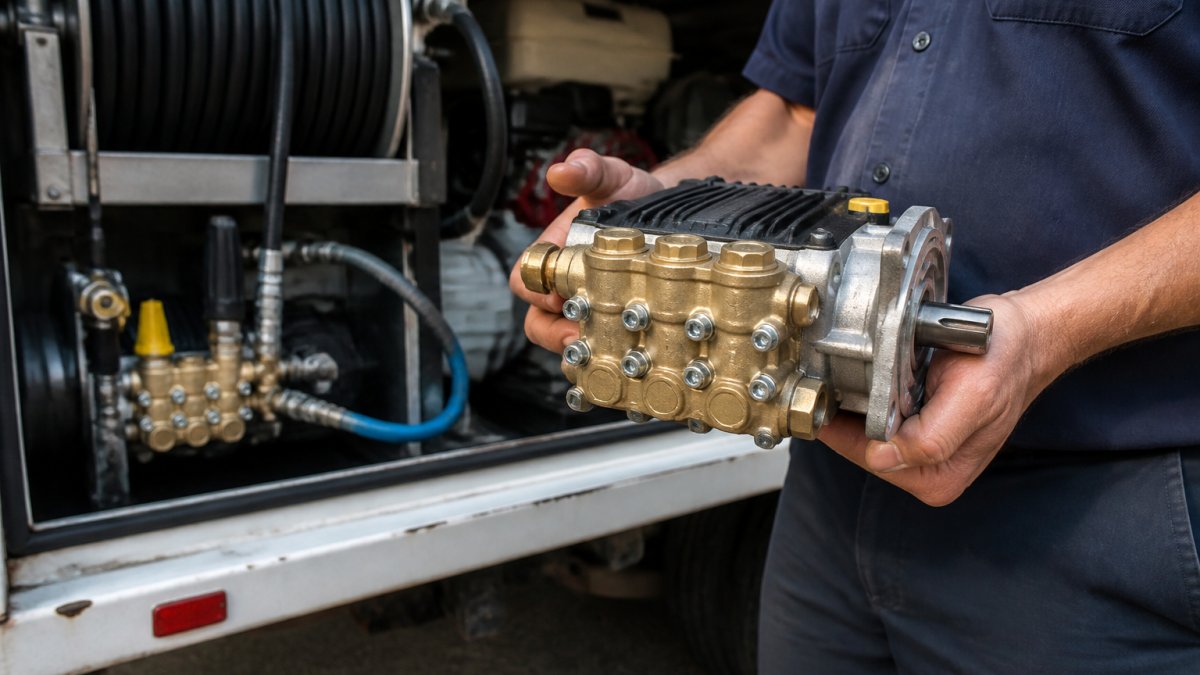
A commercial pressure washer pump earns its keep on duty cycle, not peak rating. Two pumps can both say 3,000 PSI, and only one will survive a full shift for years. The difference is construction and the operating conditions it was built for.
Industrial-Duty Selection Criteria
Before comparing models, decide what the pump has to survive. These five criteria separate industrial pumps from light-duty replacements:
General Pressure Washer Pump TC1506 GUI - Stens 030-007 →
- Pump type and construction. Triplex plunger pumps use three plungers to hold pressure better than cheaper axial designs, which is why they dominate commercial and industrial work. Axial pumps suit occasional homeowner use but wear quickly under daily commercial load.
- Duty cycle. Industrial pumps are rated for continuous or near-continuous operation. An intermittent-rated pump will overheat and fail if you run it all day. Match the duty rating to your actual operating hours.
- Water temperature. Standard pumps handle cold water. For hot water grease or oil removal, you need a pump rated for the inlet temperature you actually feed it; exceeding it destroys seals fast.
Pump Options by Application
| Pump | Type | Max Pressure | Flow | Best For |
|---|---|---|---|---|
| General TC1506 (Stens 030-007) | Triplex plunger, gas, flanged | 2,700 PSI | 2.6 GPM | Direct-couple gas machines |
| Stens 758-989 | Horizontal gas flanged | 3,000 PSI | 2.4 GPM | High-pressure gas cleaning |
| Pumptec 81860 Waterhorse | 12V DC electric | 600 PSI | Eco-version | Portable sanitation, mobile cleaning |
| Pumptec 80011 | Electric pump motor set | 1,200 PSI | 3.17 GPM | Commercial equipment replacement |
| Pumptec 80346 | Electric pump motor set | 1,200 PSI | 3.1 GPM | Hard-surface, truck-mount cleaning |
Triplex plunger pumps, like the General TC1506, are the default for daily commercial work because they hold pressure and can be rebuilt. For hard-surface and truck-mount cleaning, motor-and-pump sets like the Pumptec 80346 run on 120 volts through a full shift. For high-pressure gas work, the Stens 758-989 delivers 3,000 PSI at 2.4 GPM with a thermal valve against overheating.

New vs. Rebuilt: The Core Condition Decides
A new pump is the right call when the housing is cracked, the shaft is worn, or the pump is past its service life. A rebuild is better when damage is limited to seals, valves, or a worn unloader. Pumptec pumps are designed to be easy to rebuild, and if the body and plungers are sound, a seal and valve kit restores performance for far less than a new unit.
How to Choose Pressure Washer Pump Suppliers
Pressure washer pump suppliers are not interchangeable, and the differences show up the moment a machine goes down. Compare them on what matters to a working crew: pump range, fitment support, stock depth, warranty and returns, and parts availability.
Compare Suppliers by the Job You Run
Match the supplier to the work:
- Fleet and truck-mount operations. You need a supplier stocking complete pump-and-motor assemblies, not just bare pumps, who can ship overnight. Look for motor-and-pump sets in the 1,200 PSI class and above, plus unloaders, nozzles, and hoses.
- Mobile and portable cleaning. You need 12V DC and low-pressure electric pumps, plus wiring and switch gear. A supplier carrying only gas flanged pumps will leave you stranded.
- Hard-surface and industrial cleaning. You need triplex plunger pumps with serviceable seals and valves, and a supplier who stocks rebuild kits. If they cannot sell the seal kit, they cannot keep you running.
The Five Questions That Separate Suppliers
Ask these before ordering; the answers tell you more than any product page:
- Can they confirm fitment before the sale? A good supplier asks for your old pump's part number, shaft diameter, flange pattern, and port threads, then confirms the match in writing. A weak one ships what you clicked.
- How deep is their stock? A supplier who lists a pump as "in stock" but drop-ships from a third party adds days to your downtime. Ask whether the part ships from their own warehouse.
- What are the warranty terms, and who honors them? Manufacturer warranty and supplier warranty are not the same thing. The Federal Trade Commission guidance on warranty and return rights explains what warranties and return policies must disclose, which helps you compare terms fairly.
- What is the return policy if the fit is wrong? Confirm who pays return shipping and whether there is a restocking fee. On a heavy pump, return freight can exceed the price difference between suppliers.
- Do they stock replacement parts? A pump is only as good as its serviceability. If the supplier cannot sell seals, valves, and unloaders, you will buy a whole new pump next time instead of a kit.
Technical Support Is the Real Differentiator
Product listings do not answer the question that matters most: will someone help you identify the right pump when the part number is worn off? A supplier with a technical support line staffed by pump people can identify a match from a photo of the pump and machine rating plate. One without leaves you guessing.
Availability and Shipping Beat Price
For a crew losing money every day a machine is down, availability beats price. A pump that costs a little more but ships today with a manufacturer warranty is usually cheaper than a bargain arriving next week and failing in a month. Weigh stock location, shipping speed, and delivery cost together with purchase price.
Total Cost of Ownership: Price, Shipping, Warranty, and Downtime
The sticker price is the smallest part of the real cost. Total cost of ownership adds shipping, warranty coverage, and the cost of a machine sitting idle. Weigh these together:
- Purchase price and any bulk or wholesale pricing
- Shipping speed and delivery cost
- Warranty terms and who honors them
The Federal Trade Commission guidance on warranty and return rights explains what warranties and return policies must disclose, which helps you compare terms fairly.
New vs. Rebuilt Pumps: When Repair Makes More Sense
Downtime is the real cost of a wrong pump order, and getting the fit right the first time keeps crews working. At 4J Total Supply, we stock industrial-grade pumps and spray equipment, help you match the exact replacement to your machine, and ship fast so your equipment gets back to work.
Check out 4J Total Supply for your next industrial pressure washer pump and get the right part the first time.
Frequently Asked Questions
How do I find the right replacement pump for my pressure washer?
Start with the pump's model or part number stamped on the crankcase or manifold. Then confirm four specs: PSI, GPM, shaft diameter, and mounting type. A flanged horizontal pump with a 3/4-inch hollow shaft, like the General TC1506 GUI, only fits engines built for that bolt pattern. If the tag is worn off, measure the shaft and photograph the mounting flange before ordering.
Can I replace a pressure washer pump without replacing the whole machine?
Yes, in most cases. If the engine or motor still runs and the frame and unloader are sound, a replacement pump assembly restores full performance for a fraction of a new unit's cost. Pumptec sets such as the 80011 are sold as direct replacement assemblies for models including the Olympus 1200 and Nautilus 1200, which keeps an otherwise serviceable machine in rotation.
What specifications should I compare when buying an industrial pressure washer pump?
Compare PSI and GPM first, since they set cleaning power and are rated together. Then check RPM, shaft diameter, flange or hollow-shaft mounting, inlet and discharge port threads, and maximum fluid temperature. A 2,700 PSI, 2.6 GPM pump and a 3,000 PSI, 2.4 GPM pump are not interchangeable just because the PSI looks close.
Where can I buy a pump for a pressure washer when I need it fast?
Buy from a supplier that lists real stock status and ships the same day on in-stock items. Pumptec's 81860 Waterhorse is listed as in stock now, while made-to-order sets like the 80011 ship direct from the manufacturer in 7 to 10 business days. Confirm availability by phone before ordering if your crew is down, since a day of downtime can cost about $1,000.