

Agricultural Pump Selection: Expert Guidance
Table of Contents
- Understanding Agricultural Pump Types and Applications
- Assessing Your Water Source and Site Conditions
- Calculating Flow Rate and Total Dynamic Head
- How to Choose an Irrigation Pump for Your Operation
- Irrigation Pump Sizing: A Worked Example
- Irrigation Pump Efficiency and Operating Costs
- Material Compatibility, Maintenance, and Seasonal Planning
- Frequently Asked Questions
Last Updated: October 11, 2026
Understanding Agricultural Pump Types and Applications
Proper agricultural pump selection prevents inefficiency, equipment failure, and wasted resources. At 4J Total Supply, we help agricultural professionals source the exact pumps and components needed for their specific conditions.
Agricultural pump selection depends on three core factors: water source, irrigation method, and power availability.
Centrifugal vs. Submersible Pump for Irrigation
Centrifugal pumps sit above ground and pull water toward them; submersible pumps sit inside the water source. This difference fundamentally changes performance.
Centrifugal pumps work best with close, consistent water sources and handle large volumes efficiently.
Submersible pumps eliminate suction lift entirely, making them ideal for deep wells or unstable water sources. The trade-off: higher upfront cost and more maintenance.
Diesel, Electric, and Solar-Powered Options
Power source determines operating costs and long-term flexibility. Diesel offers portability and grid independence. Electric delivers consistent power at lower per-hour costs. Solar requires high upfront investment but eliminates fuel costs.
Diesel suits operations that move equipment frequently or lack grid access. Electric suits farms with stable grid connections. Solar works best in high-sun regions over a 10-15 year timeline.
Assessing Your Water Source and Site Conditions
Your water source determines pump type, capacity, and operating strategy. Understanding your specific conditions prevents costly mistakes.
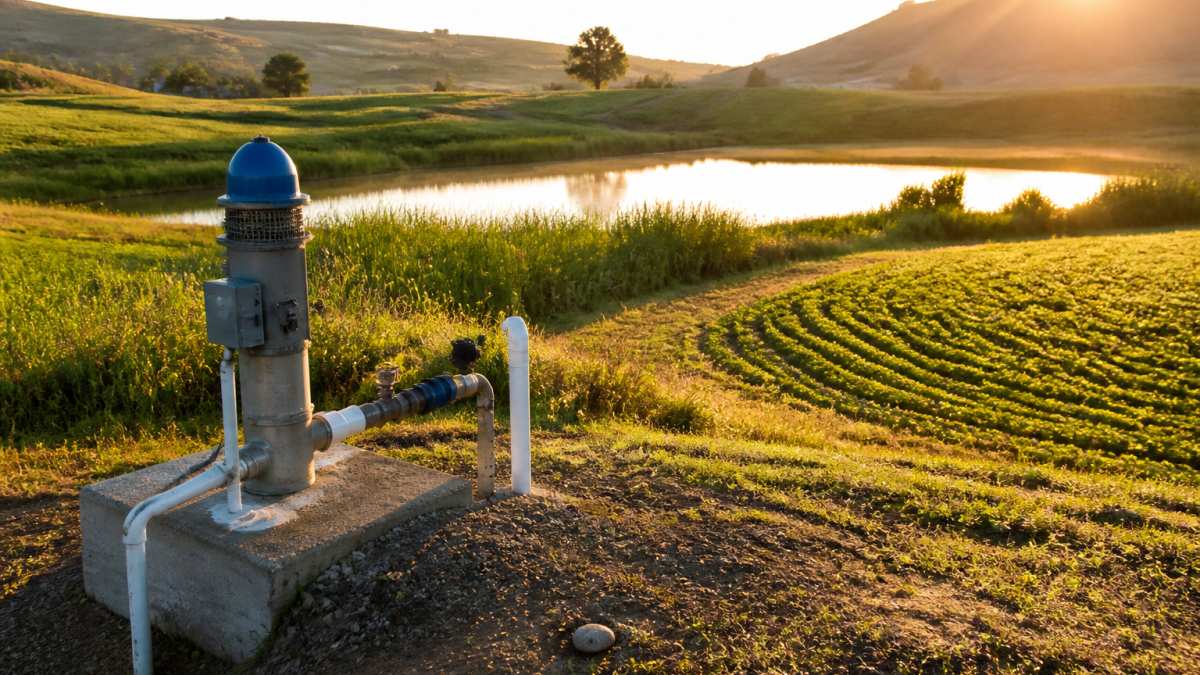
Groundwater, Surface Water, and Elevation Factors
Groundwater comes from wells. Surface water comes from ponds, rivers, or streams. Each requires different pump handling.
Wells demand submersible or deep-set centrifugal pumps. Water sits 50+ feet below ground, requiring either a submersible pump or a centrifugal pump at the well head with extended suction lines.
Surface water sources like ponds or streams allow centrifugal pumps to operate easily since water sits at or near ground level.
Elevation changes matter enormously.
Calculating Flow Rate and Total Dynamic Head
These two numbers define your pump's job. Get them wrong, and you'll either undersupply your fields or waste energy running an oversized system.
Determining Gallons Per Minute (GPM) Requirements
Flow rate measures how much water your system needs per minute. Calculate it by identifying irrigated acreage and irrigation method.
Drip irrigation needs 0.5-1 GPM per 100 sq ft; sprinkler systems need 1-2 GPM per 100 sq ft; flood irrigation demands 5+ GPM per 100 sq ft.
Multiply your method's requirement by total area. A 10-acre field using sprinklers needs roughly 2,000-4,000 GPM, which becomes your target flow rate.
Understanding Suction Lift and Pressure Demands
Suction lift is the vertical distance water must travel upward to reach the pump inlet. Total dynamic head includes suction lift, elevation gain to your irrigation area, and friction losses in pipes.
A well 30 feet deep creates 30 feet of suction lift. If your irrigation area sits 50 feet higher, that's another 50 feet of head. Add pipe friction losses (typically 5-10 feet per 100 feet of horizontal pipe), and total dynamic head might reach 100+ feet.
How to Choose an Irrigation Pump for Your Operation
Match pump capacity to calculated flow rate and total dynamic head. A pump rated for 2,000 GPM at 80 feet will underperform if your actual requirement is 3,000 GPM at 100 feet.
Matching Pump Capacity to Crop and Irrigation Method
Different crops demand different water volumes. Alfalfa needs heavy, consistent irrigation; pasture needs moderate, seasonal irrigation; vegetables need precise, frequent watering.
Irrigation method constrains choices. Drip systems require lower pressure and smaller flow rates; sprinkler systems need higher pressure and larger flow rates; flood irrigation demands massive flow but minimal pressure.
Match requirements to a pump's performance curve, a graph showing flow at different pressure levels.
Irrigation Pump Sizing: A Worked Example
Scenario: A 20-acre alfalfa field served by a well 40 feet deep. The irrigation area sits 30 feet higher than the well. Sprinkler irrigation is the chosen method.
Step 1: Calculate Required Flow Rate (GPM)
Start with acreage and irrigation method:
- Field size: 20 acres
- Acreage in square feet: 20 acres × 43,560 sq ft/acre = 871,200 sq ft
- Sprinkler irrigation requirement: 1.5 GPM per 100 sq ft (mid-range for typical agricultural sprinklers)
Round to 13,100 GPM as your target flow rate.
Step 2: Calculate Total Dynamic Head (TDH)
Total dynamic head is the sum of four components:
- Suction lift (distance water rises from well to pump): 40 feet
- Elevation gain (height from well to irrigation area): 30 feet
-
Friction loss in pipe (resistance as water flows through 500 feet of discharge line):
- For a 4-inch discharge pipe carrying 13,100 GPM, friction loss is approximately 3 feet per 100 feet of pipe (from standard hydraulic tables)
- Total friction: (500 ft ÷ 100) × 3 ft = 15 feet
-
Pressure requirement at sprinkler heads (typical sprinkler systems need 40-60 PSI; use 50 PSI)
- Convert PSI to feet of head: 50 PSI × 2.31 ft/PSI = 115.5 feet
Total Dynamic Head: 40 + 30 + 15 + 115.5 = 200.5 feet
Round to 200 feet TDH for pump selection.
Kappa 43 Diaphram Pump without Gear Box →
Step 3: Verify Against Pump Performance Curve
You now need a pump delivering approximately 13,100 GPM at 200 feet of head. Consult the manufacturer's performance curve for candidate models. A typical large centrifugal pump rated for this duty (e.g., a 6-inch or 8-inch discharge model from a major manufacturer) will show:
- At 13,100 GPM, the pump delivers roughly 200 feet of head
- The duty point (13,100 GPM, 200 ft) should fall near the middle of the curve, not at the extreme left (low flow, high head) or extreme right (high flow, low head)
- Efficiency at this duty point should be 75-85%; if it's below 70%, the pump is oversized or undersized
- Power requirement (brake horsepower) at this duty point should be calculated: BHP = (GPM × TDH) ÷ (3,960 × efficiency). For this example: (13,100 × 200) ÷ (3,960 × 0.80) ≈ 825 BHP
Step 4: Select Power Source and Final Model
With 825 BHP required, you need either:
- A large diesel engine (typically 800-900 HP) or electric motor (800+ HP at 480V three-phase)
- A solar array is impractical for this duty; solar works best for smaller systems (under 50 GPM) or lower head (under 100 feet)
For a permanent installation with grid access, an electric motor is more economical. For a portable or remote system, diesel is standard.
Irrigation Pump Efficiency and Operating Costs
Energy consumption drives long-term costs far more than purchase price. Inefficient pumps waste thousands annually, compounding over the system's lifetime.
Energy Consumption and Lifecycle Cost Comparison
Efficiency Fundamentals
Pump efficiency varies dramatically based on duty-point matching. A well-matched pump achieves 75-85% efficiency; a mismatched pump might achieve only 40-50%. The difference compounds over years.
A 10-acre sprinkler system running 150 days per season: at 50% efficiency, 8,000 GPM at 100 feet TDH requires 400 BHP; at 80% efficiency, only 250 BHP.
Lifecycle Cost Breakdown by Power Source (15-Year System Life)
Electric (Grid-Connected, 480V Three-Phase)
- Pump and motor purchase: $8,000-12,000
- Installation and electrical work: $3,000-5,000
- Annual electricity cost (150 BHP × 1,800 hours ÷ 0.746 kW/HP × $0.12/kWh): approximately $435/year
- 15-year electricity cost: $6,525
Diesel (Portable or Remote)
- Pump and engine purchase: $12,000-18,000
- Installation and fuel tank: $2,000-4,000
- Annual fuel cost (150 BHP × 1,800 hours ÷ 0.45 lb/BHP-hr × $3.50/gallon ÷ 7.1 lb/gallon): approximately $2,400/year
- 15-year fuel cost: $36,000
Solar (High-Sun Region, Submersible System)
- Solar array (5 kW), submersible pump, controller, and battery storage: $25,000-35,000
- Installation and electrical: $5,000-8,000
- Annual fuel cost: $0 (after setup)
- Annual maintenance (panel cleaning, battery monitoring, inverter service): $200-400
Key Takeaway: Electric power is lowest-cost for grid-connected farms running 1,500+ hours per season. Diesel is highest-cost but offers portability and independence.
Matching Pump Selection to Efficiency
Do not oversize your pump for worst-case scenarios. An oversized pump running at partial load operates far from its design point and wastes energy daily.
A 10-acre field needs 5,000 GPM at 80 feet normally. A farmer buys a pump rated 8,000 GPM at 100 feet "just in case." At 5,000 GPM, it operates at 60% efficiency instead of 80%, costing $4,000-8,000 in wasted energy over 15 years.
Instead, size for typical years and plan for supplemental sources or reduced irrigation during drought.
Monitoring Efficiency Over Time
Pump efficiency degrades as impellers wear, seals leak, and bearings loosen. A pump losing 15-20% efficiency still works but wastes energy daily.
Warning signs of declining efficiency: flow drops 10-15% with no duty-point change, discharge pressure rises unexpectedly, motor current draw increases, or vibration or unusual noise increases.
Address these problems early. A $500 impeller replacement or seal kit can restore efficiency and save thousands in wasted energy.
Material Compatibility, Maintenance, and Seasonal Planning
Pump longevity depends on matching materials to your water quality and operating environment.
Handling Sediment, Corrosion, and Water Quality Risks
Sediment-laden water clogs standard pump impellers. Corrosive groundwater attacks steel components. Acidic or alkaline water degrades seals and gaskets.
Anodized aluminum resists corrosion better than bare steel. Diaphragm pumps like the Kappa 43 Diaphram Pump without Gear Box handle abrasive materials and suspended solids that would damage centrifugal impellers, delivering 10.5 GPM at 560 PSI for $899.

Test your water annually. High sediment requires upstream filtration; corrosive water demands material upgrades; poor water quality leads to premature failure.
Drought Planning and System Optimization
Build redundancy into critical systems. A backup pump prevents total failure if your primary pump breaks mid-season. Store replacement impellers and seals for quick repairs and maintain supplier relationships for rapid parts sourcing.
Selecting the right agricultural pump requires matching three variables: your water source, your required flow and pressure, and your power availability. We carry models like the Udor Kappa 55 without gearbox for large-scale operations and the Udor KAPPA-18/12-HP Volt Diaphragm Pump for smaller applications.


Frequently Asked Questions
How do I calculate the flow rate needed for an agricultural pump?
Flow rate (in GPM) depends on your irrigation method and acreage. For drip irrigation, multiply irrigated acres by 100-150 GPM per acre. For sprinkler systems, use 200-300 GPM per acre. Divide total GPM needed by your irrigation hours per day to find peak flow demand. For example, 10 acres under sprinkler irrigation for 8 hours requires roughly 250-375 GPM peak capacity. Consult your irrigation system's design specifications or contact 4J Total Supply for guidance on your specific setup.
What is total dynamic head, and why does it matter for agricultural pump selection?
Total dynamic head (TDH) is the total height the pump must lift water plus pressure losses from friction in pipes and fittings. It includes static lift (vertical distance from water source to discharge point), suction lift (distance from pump to water surface), and pressure losses in the system. A pump rated at 560 psi can overcome significant head, but oversizing wastes energy and money. Underestimating head causes inadequate pressure and poor irrigation performance. Calculate TDH by measuring elevation change, adding frictional losses from pipe length and diameter, and including any pressure requirements for your irrigation method.
What is the difference between centrifugal and submersible pumps for irrigation?
Centrifugal pumps sit above ground and pull water from below (suction lift up to about 25 feet). They suit surface water sources and wells with shallow water tables. Submersible pumps sit inside the well and push water upward, handling deeper wells and higher head demands without suction limitations. Centrifugal pumps are easier to maintain and repair; submersible pumps require removal for service. Submersible models work well for deep groundwater; centrifugal pumps are more economical for shallow sources and large surface water operations.
How can I improve the energy efficiency of an irrigation pump?
Select a pump sized to your actual duty point (the GPM and pressure your system requires) rather than oversized equipment. Oversized pumps waste energy. Use variable frequency drives (VFDs) to adjust pump speed to demand. Maintain filters and clean intake screens to reduce friction losses. Upgrade to energy-efficient motor designs and consider solar-powered options for long-term cost savings. High-efficiency diaphragm pumps like the Kappa series handle abrasive and chemical-laden fluids while maintaining performance. Regular maintenance, proper pipe sizing, and system commissioning also reduce energy waste significantly.