

Best Agricultural Spray Pump Brands 2026: What to Buy?
Last Updated: November 1, 2026
Quick Summary
The best agricultural spray pump brands in 2026 are Udor and Delavan, based on flow rate, pressure, chemical compatibility, and durability. Udor's Kappa 55 leads for high-volume row crop and turf at 15 gpm and 560 psi, while the Delavan PowerFLO 5850 is the budget electric pick at $189.75.
- The sprayer market is projected to grow from USD 4.8 billion in 2026 to USD 6.7 billion by 2031.
- The Udor Kappa 43 delivers 10.5 gpm at up to 560 psi and costs $899.00.
- The Udor Kappa-18 12-Volt provides 4.2 gpm at 70 psi for spot spraying and injection.
- A clogged inlet strainer is the most common cause of low pressure and lost prime.
- Flush the pump with clean water after every chemical application.
Table of Contents
- Quick Comparison: Best Agricultural Spray Pump Brands for 2026
- Agricultural Sprayer Pump Types: Which One Fits Your Operation?
- Diaphragm Spray Pump for Agriculture: Why It Handles Tough Chemicals
- Top Picks: Udor Kappa 43 and Kappa 55 Diaphragm Pumps
- Electric and Compact Options: Udor Zeta 70, Kappa-18, and Delavan PowerFLO
- Sprayer Pump Troubleshooting: Fixing Low Pressure and Prime Problems
- Agricultural Spray Pump Maintenance: A Simple Seasonal Routine
- Choosing the Right Pump and Parts From 4J Total Supply
- Frequently Asked Questions
Quick Comparison: Best Agricultural Spray Pump Brands for 2026
The global agricultural sprayer market is projected to grow from USD 4.8 billion in 2026 to USD 6.7 billion by 2031, a 6.90% CAGR, according to Mordor Intelligence's sprayer market forecast. That growth is driven largely by precision spraying, and the pump at the center of every rig determines whether that precision holds up in the field. At 4J Total Supply, we field calls daily from growers and landscape crews asking which agricultural spray pump actually survives a season of harsh chemistry. This guide ranks the best agricultural spray pump brands in 2026 by flow rate, pressure, chemical compatibility, and real-world durability.
Here is how the five pumps we stock stack up:
| Pump | Max Flow | Max Pressure | Price | Best For |
|---|---|---|---|---|
| Udor Kappa 55 | 15 gpm | 560 psi | $1,079.99 | High-volume row crop and turf |
| Udor Kappa 43 | 10.5 gpm | 560 psi | $899.00 | Mid-size engine-driven sprayers |
| Udor Kappa-18 12V | 4.2 gpm | 70 psi | $1,059.00 | Spot spraying and injection |
| Udor Zeta 70 | High-volume horticulture | Moderate | $799.99 | Nursery and greenhouse work |
| Delavan PowerFLO 5850 | 5 gpm | 60 psi | $189.75 | Budget electric bypass setups |
Agricultural Sprayer Pump Types: Which One Fits Your Operation?
An agricultural sprayer pump is the component that moves liquid fertilizer, pesticide, or herbicide from the tank to the nozzle at a controlled flow and pressure. Three designs dominate the market, and each suits a different job.
Diaphragm pumps use a flexible membrane to push fluid, so they tolerate abrasive and suspended materials without the wear that ruins other designs. Piston and plunger pumps deliver higher pressure for demanding applications but need cleaner fluids. Centrifugal pumps move high volume cheaply but struggle with pressure consistency.
Match the pump type to your chemical first, then your acreage.
Diaphragm Spray Pump for Agriculture: Why It Handles Tough Chemicals
A diaphragm spray pump for agriculture is the default choice when your tank carries abrasive suspensions, wettable powders, or liquid fertilizers that chew through seals. The diaphragm never touches the fluid directly, so aggressive chemistry has nothing to corrode.
Udor builds its Kappa line with anodized aluminum housings and stainless steel liquid-handling parts, plus heavy-duty pre-formed urethane diaphragms. The result: pumps that can run dry without damage and self-prime.
A diaphragm design is built to handle chemical exposure and dry running. If you spray de-icing materials, suspension products, or pesticides, this is the architecture to consider.
Top Picks: Udor Kappa 43 and Kappa 55 Diaphragm Pumps
Udor's Kappa series offers diaphragm pumps for a range of spraying needs, and two models are highlighted below.
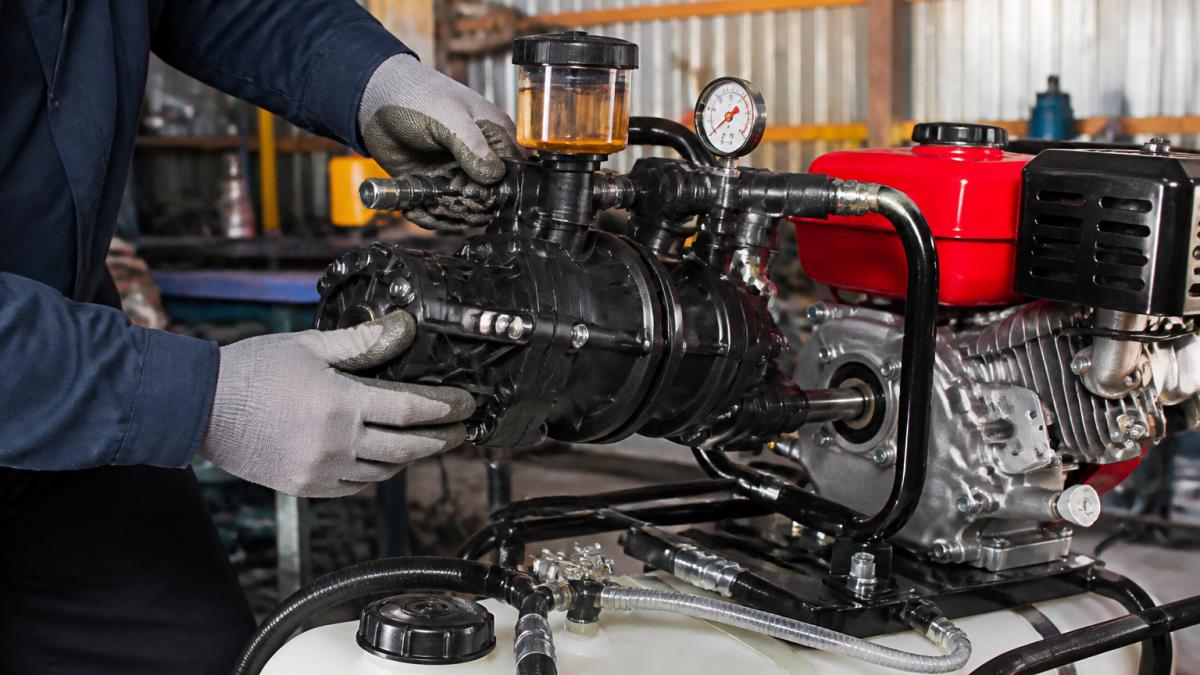
The Kappa 43 Diaphragm Pump delivers 10.5 gpm at up to 560 psi, with a three-cylinder design, a 1-inch hose barb inlet, and dual 1/2-inch outlets. It ships with a control unit and gearbox for 5 to 6.5 hp engines, and it runs $899.00. For mid-size engine-driven rigs, this is our pick.

Step up to the Udor Kappa 55 and you get 15 gpm at the same 560 psi, a built-in pulsation dampener, and a 1-1/4-inch inlet for higher volume. At $1,079.99, it suits larger row crop and turf operations pushing more gallons per acre.

Best for: growers running engine-driven sprayers who need pressure and volume in one pump.
Electric and Compact Options: Udor Zeta 70, Kappa-18, and Delavan PowerFLO
Electric and compact pumps cover the jobs where a gas engine makes no sense: spot spraying, injection systems, and small utility rigs.
Kappa 43 Diaphram Pump without Gear Box →
The Udor Zeta 70 features anodized aluminum bodies with plasticized aluminum heads, stainless steel valves, and a 1-1/4-inch inlet, priced at $799.99. The Udor Kappa-18 12-Volt pairs a two-diaphragm pump with a 12-volt DC motor for 4.2 gpm at 70 psi, priced at $1,059.00.

For budget-conscious setups, the Delavan 5850-111E PowerFLO runs 5 gpm at 60 psi on 12 VDC, with Viton valves and a Santoprene diaphragm for corrosion resistance. At $189.75, it self-primes up to 14 vertical feet and can run dry without damage.
Sprayer Pump Troubleshooting: Fixing Low Pressure and Prime Problems
Low pressure and lost prime cause most sprayer downtime, and both usually trace to a handful of fixable causes. Check them in this order before assuming the pump has failed.
- Clogged inlet strainer: the most common culprit. Clean it after every tank of suspension product.
- Air leak on the suction side: tighten hose clamps and inspect for cracked fittings.
- Worn or stuck check valves: debris or chemical residue keeps them from sealing.
- Torn diaphragm: a drop in pressure with fluid in the oil bath signals a failed membrane.
- Worn nozzle tips: pressure reads fine at the gauge but drops at the boom.
If the pump won't prime, verify the inlet is below tank level and the suction hose has no pinholes. Diaphragm pumps self-prime, but only when the suction line is airtight.
Agricultural Spray Pump Maintenance: A Simple Seasonal Routine
Agricultural spray pump maintenance comes down to four habits, and skipping them is why pumps fail mid-season. Precision agriculture is reshaping sprayer demand, per CropLife's coverage of spray drone development, but the maintenance fundamentals haven't changed.
- Flush the pump with clean water after every chemical application
- Check oil level and clarity through the sight gauge weekly
- Inspect diaphragms and check valves at the start of each season
- Torque diaphragm bolts and inspect hoses for cracks monthly
- Store the pump with a rust-inhibiting flush before winter
Choosing the Right Pump and Parts From 4J Total Supply
Matching pump to operation is the decision that protects your season. Start with your required flow and pressure, confirm chemical compatibility, then choose the drive type your rig supports. Get those three right and the brand choice becomes easy.
At 4J Total Supply, we stock the Udor and Delavan pumps above alongside the hoses, fittings, and rebuild kits that keep them running. Our team helps you find the right part for your equipment, and we focus on fast delivery. As one customer put it, "I was confused as to what part I needed. But 4J directed me to the exact part, and provided a chart to help me in the future."
Market forecasts vary on total size, but the direction is clear: Fortune Business Insights projects steady sprayer market growth through 2034, which means parts availability and support will matter as much as the pump itself.
Frequently Asked Questions
What are the best agricultural spray pump brands in 2026?
There is no single best brand for every operation. Diaphragm pumps from Udor and Delavan are offered for spraying applications, and listed features include the ability to run dry and self-prime, and handle suspension products. The right pick depends on flow rate, pressure, and drive type. A 10.5 gpm Kappa 43 at $899.00 suits medium turf and horticulture work, while a 15 gpm Kappa 55 at $1,079.99 fits larger acreage. Match the pump to your nozzle demand before brand loyalty.
Which agricultural sprayer pump type is best for chemical application?
Diaphragm pumps are a good fit for chemical application, and the Kappa series can run dry and handles pesticides and suspension products. They handle liquid fertilizers, abrasive materials, suspension products, and pesticides. Centrifugal pumps move high volume at low pressure, which suits water transfer but not precise chemical metering. For pest control and turf spraying where pressure stability matters, choose a diaphragm spray pump for agriculture with a pressure regulator and gauge.
What causes an agricultural sprayer pump to lose pressure?
Low pressure usually traces to a clogged inlet strainer, a worn diaphragm, a stuck check valve, or air entering the suction line. Start with sprayer pump troubleshooting basics: check the strainer, inspect hose fittings for cracks, and confirm the pump is priming. Replace worn parts before assuming the pump is finished.
How often should I perform agricultural spray pump maintenance?
Check oil level and sight gauges before every use, and flush the pump after each chemical application. Change the oil bath at the interval your manual specifies, using 20 oz of Udor Lube 40W or a 30W non-detergent alternative on Zeta 70 pumps. Store the pump with the system flushed and the pressure released. A simple seasonal routine prevents most mid-season failures.
How do I choose the right spray pump for my farm?
Start with required flow and pressure. Add up nozzle output in gallons per minute, then choose a pump rated above that figure. Confirm the drive type: gas engine, PTO, hydraulic, or 12-volt electric. Check port sizes match your plumbing and that the pump handles your chemicals. A 4.2 gpm Kappa-18 at $1,059.00 is one option for smaller spraying needs, while a 15 gpm Kappa 55 at $1,079.99 offers higher flow. Ask a supplier to confirm fit before ordering.
Your sprayer is only as reliable as the pump bolted to it, and a mid-season failure costs far more than the part. 4J Total Supply carries the diaphragm pumps, electric options, and replacement components to keep every rig running, backed by a large inventory, expert parts guidance, and fast delivery. Get started with 4J Total Supply and spec the right agricultural spray pump for your operation today.
