

8 Common Reasons for Pressure Washer Downtime
Last Updated: November 4, 2026
Quick Summary
Pressure washer downtime is the time a machine sits idle because of a fault, and it usually traces to a short list of predictable failures. Work from the cheapest, most visible causes toward the expensive ones: water supply, inlet filter, nozzle, hose, air leaks, and only then the pump.
- Low pressure is the number one reason a pressure washer comes off the truck.
- Clear a clogged nozzle with a wire tip cleaner, then flush it before replacing.
- Air in the system makes a pressure washer sputter, surge, and lose pressure in bursts.
- Stale fuel is the most common reason a seasonal gas pressure washer will not start.
- A clogged burner nozzle produces a weak or no flame and is a common cause of no-heat calls.
Table of Contents
- Why Pressure Washer Downtime Starts With a Diagnostic Order
- Low Pressure and Pressure Loss: The Most Common Downtime Trigger
- Water Supply and Inlet Filter Failures That Stop Flow
- Air Trapped in the Pump and Leaks in the Inlet Plumbing
- Pressure Washer Problems and Solutions for Pump and Motor Faults
- When Your Pressure Washer Loses Pressure After a Few Seconds
- Pressure Washer No Pressure: Unloader Valve and Relief Valve Checks
- Gas Engine, Fuel, and Hot-Water Burner Shutdowns
- Keep the Machine Running, Not Waiting
- Frequently Asked Questions
Why Pressure Washer Downtime Starts With a Diagnostic Order
Pressure washer downtime is the time a machine sits idle because of a fault, and it often comes from a short list of predictable failures.
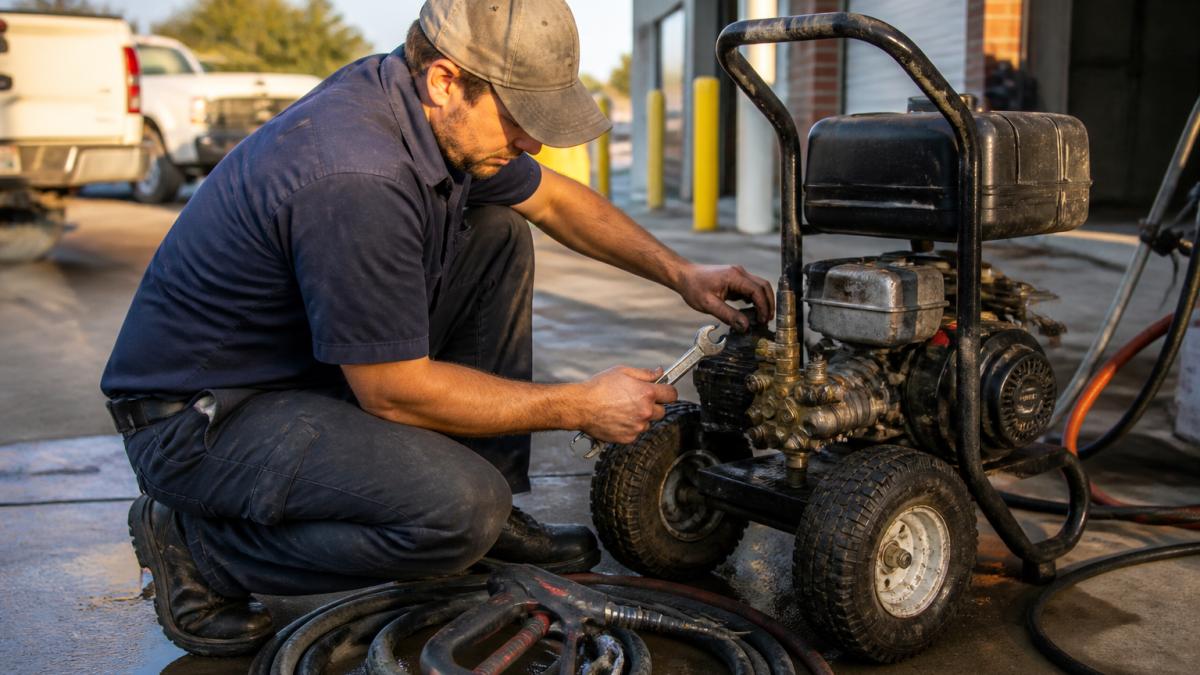
Work from the cheapest, most visible causes toward the expensive ones: water supply, inlet filter, nozzle, hose, air leaks, and only then the pump.
- Water supply and inlet filter
- Nozzle, wand, and gun
- High-pressure hose
- Air in the system
- Unloader and relief valve
- Pump, belt, and motor
- Engine, fuel, and burner on gas and hot-water units
That order keeps most jobs short. For a wider walkthrough of pump failures, our guide on troubleshooting common soft wash pump failures follows the same logic.
Work through the cheapest, most visible causes first, in this order.
| Order | Check |
|---|---|
| 1 | Water supply and inlet filter |
| 2 | Nozzle, wand, and gun |
| 3 | High-pressure hose |
| 4 | Air in the system |
| 5 | Unloader and relief valve |
| 6 | Pump, belt, and motor |
| 7 | Engine, fuel, and burner on gas and hot-water units |
Low Pressure and Pressure Loss: The Most Common Downtime Trigger
Low pressure is the number one reason a pressure washer comes off the truck. The usual culprits are a clogged nozzle, a kinked hose, or a restricted water supply, and all three are quick to check.
Start at the tip. A nozzle with debris or mineral buildup narrows the opening and drops pressure at the gun. Swap it and retest before touching anything else.
Clogged or Worn Nozzle, Wand, and Gun Blockages
A worn nozzle is easy to miss: the opening erodes over time, so the spray pattern widens and pressure falls off slowly.
Watch for these signs:
- Spray pattern looks uneven or fan-shaped when it should be tight
- Pressure drops at the gun but the pump sounds normal
- Water sputters or pulses at the tip
Clear a clogged nozzle with a wire tip cleaner, then flush it. If the pattern still looks wrong, replace it.
If your gun and wand are past saving, replacement parts can get you back to work without rebuilding the whole assembly.
Kinked, Blocked, or Undersized High-Pressure Hose
A kinked hose strangles flow. Unroll the full length, straighten every loop, and look for a sharp bend or a crush point where something heavy sat on it.
Then check the inside. A hose that sat with water in it can grow scale or pick up debris. Disconnect it and run water through to see if flow is restricted.
Size matters too. When a hose is kinked, blocked, or undersized, a 25 foot 4500 PSI pressure washer hose is a replacement option; it features a steel and polyester braid for kink resistance.

Water Supply and Inlet Filter Failures That Stop Flow
Inadequate water supply starves the pump, and a clogged inlet filter does the same thing from the other direction. Both show up as weak or surging pressure.
Check supply first. A garden hose that is too long, too narrow, or kinked at the spigot cannot deliver enough volume.
Then pull the inlet filter, the screen where water enters the pump that catches grit, sand, and debris.
Two more checks worth doing:
- Confirm the supply hose is not drawing from an empty tank
- Look for a partially closed valve between the source and the pump
Air Trapped in the Pump and Leaks in the Inlet Plumbing
Air in the system makes a pressure washer sputter, surge, and lose pressure in bursts. Air enters through loose fittings or a cracked inlet line, or gets trapped when the pump was run dry.
Here is how to clear it:
- Connect water and turn it on at the source
- Squeeze the trigger with the machine off to bleed the line
- Start the machine and hold the trigger until flow runs steady
- If it still sputters, check every inlet fitting for tightness
An air leak on the suction side will not show water. It pulls air in. Tighten fittings, check the O-rings, and look for cracks in the inlet plumbing.
Pressure Washer Problems and Solutions for Pump and Motor Faults
Pump and motor faults are the pressure washer problems and solutions most people fear, but they are rarely the first thing to fail.
Pump symptoms to watch:
- Pressure drops and will not recover
- Pump runs hot or makes a knocking sound
- Water leaks from the pump housing
A pump that ran dry or cavitated long enough can score its pistons or damage seals. The Stens 3000 PSI pressure washer pump includes an adjustable unloader and a thermal valve that protects the pump from overheating.

Belt Slippage, Motor Overheating, and Shutdowns
Belt slippage shows up as a squeal and a drop in pressure under load.
Check belt tension and look for cracks or a shiny, glazed surface. You can find the correct replacement pump belt to restore full drive to the pump.
On electric units, overheating often traces to a clogged motor fan cover, a bad capacitor, or a tripped thermal overload.
When Your Pressure Washer Loses Pressure After a Few Seconds
A pressure washer that loses pressure after a few seconds usually has a restriction or a failing unloader.
25 Foot 4500 PSI Pressure Washer Hose - Stens 758-709 →
The pattern tells you a lot. If pressure is fine at first and fades, suspect the unloader valve or a partially clogged nozzle.
Try this:
- Run the machine with the trigger held and watch the gauge
- Swap the nozzle and retest
- Check the unloader for a stuck or dirty valve
A restriction that only shows up under flow is often debris lodged in the nozzle or gun. Clean and retest before assuming the pump is bad.
Pressure Washer No Pressure: Unloader Valve and Relief Valve Checks
No pressure at all, or pressure that builds and then collapses, often points to the unloader valve or the relief valve. The unloader regulates pressure and diverts flow when the trigger releases.
Before you touch the unloader, rule out the cheap causes: a clogged nozzle, kinked hose, restricted inlet filter, or air in the suction line all mimic an unloader fault.
How to Test and Adjust a Pressure Washer Unloader Valve
Test the unloader with the machine running, the trigger held, and a gauge in view.
- Confirm the supply, inlet filter, and nozzle are clear.
- Start the machine and hold the trigger with the wand pointed at a safe surface.
- Note the pressure reading at the gauge.
- Turn the adjuster in small increments, pausing between turns.
- Stop when pressure holds steady at the pump's rated level.
If turning the adjuster does nothing, the valve is stuck, the seals are gone, or the spring is broken.
Watch out: never adjust the unloader with the wand pointed at a person or a fragile surface. A sudden pressure spike can whip the hose and cause injury.
Unloader vs. Relief Valve vs. Pump: Telling Them Apart
The symptom pattern separates the three suspects. Low but steady pressure with a normal-sounding pump points to the unloader or a restriction. Pressure that spikes then dumps water points to a stuck-closed unloader or failing relief valve. Pulsing or surging points to air in the suction line.
A quick field test: hold the trigger and watch the gauge while a helper briefly closes the lance valve or restricts flow. If the pump and check valves also need attention, weigh the risks of DIY maintenance against the damage a misdiagnosis or incorrect repair could cause.
Gas Engine, Fuel, and Hot-Water Burner Shutdowns
Gas-powered and hot-water units add a second layer of downtime that electric-only guides skip. On these machines the pump can be perfectly healthy and the unit still will not run, because the engine or the burner is the fault. Treat them as two separate systems and diagnose each in order.
Gas Engine No-Start and Shutdown Checks
A gas engine needs four things to run: fuel, air, spark, and compression, plus oil pressure on units with a low-oil sensor. Check them in that order, because the first three are cheap and fast and compression is not.
Start with fuel.
Next, air. A clogged air filter chokes the engine under load and can cause a rich-running stall.
Then spark. Pull the plug, inspect the electrode, and check the gap; a fouled or wet plug will not fire.
Finally, oil. Most modern gas pressure washers use a low-oil shutdown sensor that kills the engine to protect it.
Watch out: never crank a gas engine with the spark plug removed near spilled fuel or fuel vapor.
Hot-Water Burner Failures
A hot-water pressure washer adds a burner, fuel pump, and ignition circuit.
Confirm the burner has fuel and that the fuel filter and nozzle are clear.
Then check the thermostat and the high-limit switch.
Watch out: burner fuel and ignition circuits involve open flame and line voltage. Isolate power and fuel before opening the burner housing, and leave combustion adjustment to a qualified technician.
Repair or Replace: When to Stop Diagnosing
Some faults are field-fixable and some are not. A clogged filter, stale fuel, fouled plug, dirty flame sensor, or loose belt is a same-day fix with hand tools. A scored pump, cracked pump housing, failed motor winding, or burner with a failed fuel pump is a shop or replacement decision. If the repair cost approaches the price of a comparable replacement and the machine is out of warranty, replacement usually wins on uptime.
Keep the Machine Running, Not Waiting
Downtime rarely comes from one dramatic failure. It comes from a clogged filter, a worn nozzle, a kinked hose, or a belt that should have been changed last month.
At 4J Total Supply, we stock the parts that stop small faults from becoming big ones.
Get started with 4J Total Supply and keep your fleet running instead of waiting on a part.
Frequently Asked Questions
What causes a pressure washer to suddenly lose pressure?
Sudden pressure loss usually comes from four places: a clogged or worn nozzle, a kinked or blocked high-pressure hose, a restricted water supply or dirty inlet filter, or air pulled into the pump through a loose inlet connection. Work through them in that order because each takes only a minute to check. If pressure returns and then drops again after a few seconds, the unloader valve or a trapped air pocket is the more likely cause, so test the unloader next.
How do I know if my pressure washer unloader valve is bad?
A failing unloader shows up as pressure that spikes then falls, pressure that never builds at all, or water that keeps flowing from the gun after you release the trigger. Check the valve body for debris, a stuck piston, or a worn O-ring before replacing it. On an adjustable unloader, turn the adjustment slowly while watching a pressure gauge; if nothing changes, the valve is stuck or damaged and needs replacement.
Why does my pressure washer shut off after only a few minutes?
Short run times point to a protection circuit or a fuel problem rather than a pressure fault. Electric models shut down when the motor overheats, often from a restricted extension cord, low voltage, or a thermal valve tripping on a pump running without water. Gas models stall from a clogged fuel filter, stale fuel, a dirty air filter, or a low oil sensor cutting the engine. Let the unit cool, then check the simplest item first.
How often should a pressure washer pump be maintained?
Check the inlet filter and nozzle before every job, inspect the hose and fittings weekly, and change the pump oil on the interval the pump manufacturer specifies, typically after the first 50 hours and then every 200 to 500 hours depending on the model. Commercial fleets that run daily should log hours per unit so maintenance happens on schedule instead of after a breakdown. Keep a spare nozzle, filter, and hose on the truck to cut repair time.
