

7 Reasons Industrial Grade Parts Last Longer
Last Updated: November 7, 2026
Quick Summary
Industrial grade parts last longer because they are built for continuous duty and harsh conditions, qualified against standards such as ASTM, ANSI, ISO, and RMA, and expected to hold their ratings across thousands of operating hours. The grade on the box matters less than the datasheet, material spec, and warranty behind it.
- Commercial-grade components are made for light, occasional duty, while industrial-grade parts are built for continuous duty.
- A Kevlar belt holds up under a back-side idler where a standard polyester-cord V-belt wears fast.
- The OilShield Rubber Air Hose OS3850 is rated from -30°F to +190°F and carries a 3-year limited warranty.
- Loose tolerances cause vibration, friction, and heat, each of which shortens component lifespan.
- A part run well inside its ratings will usually outlast a higher-rated part run at its limit.
Table of Contents
- What Makes a Part Industrial Grade?
- Material Selection and Component Construction
- How Industrial Components in Harsh Environments Resist Failure
- Precision Machined Parts Reliability: Tolerances, Fit, and Wear
- The Lifespan of Electronic Components and Temperature Ratings
- Industrial Spare Parts Quality: How to Verify What You Buy
- Total Cost of Ownership: The Break-Even Math
- Choosing Replacement Parts That Keep Your Crew Running
- Frequently Asked Questions
What Makes a Part Industrial Grade?
Industrial grade parts are components built to keep working through heavy daily use, wide temperature swings, and constant vibration. That is the short answer to why industrial grade parts last longer.
The difference shows up in the details. A commercial-grade part is built for light duty and short cycles. An industrial-grade part is built for the long haul.
Here is the core distinction:
- Commercial-grade components are made for light, occasional duty. They are typically rated for intermittent cycles, moderate temperatures, and controlled indoor environments. Think of a consumer air hose used on a weekend project.
- Automotive-grade components meet vehicle-specific standards for vibration, heat, and fluid exposure. They are qualified against OEM specifications and often carry standards such as SAE J20 for coolant hose or SAE J517 for hydraulic hose. Automotive grade is rigorous, but it is scoped to a vehicle platform, not to a continuous-duty plant floor.
- Industrial-grade components are built for continuous duty and harsh conditions. They are commonly qualified against standards such as ASTM, ANSI, ISO, and RMA classifications, and they are expected to hold their ratings across thousands of operating hours rather than a defined vehicle service interval.
The labels are not interchangeable, and they are not regulated the same way. A manufacturer can print "industrial grade" on a box without filing it with any agency.
That is why the grade on the box matters less than the specs inside it. A part sold as industrial grade should be able to show you:
- A stated operating temperature range, not just "high heat"
- A pressure rating at a stated temperature
- The material specification for the core, cover, and reinforcement
- The standard or classification the part was tested against
- A traceable part number and lot or date code
- Warranty terms that match the duty cycle claimed
A common pattern is that two parts look identical on the shelf but carry very different paper trails. The one with the full spec sheet is usually the one built to last. When a supplier cannot produce the datasheet or the material callout, treat the grade claim as marketing until proven otherwise.
Watch out: a part labeled "heavy duty" or "premium" is not the same as one labeled industrial grade. Those words have no agreed definition, so always fall back to the numeric ratings and the standard cited on the datasheet.
Material Selection and Component Construction
Material choice is the first reason industrial parts outlast cheap alternatives. A part made from the right compound handles stress instead of cracking under it.
Take belts. Standard V-belts use polyester cords. A Kevlar belt swaps those for much stronger Kevlar cords. Under a back-side idler, a standard belt wears fast. The Kevlar version holds up.
Hoses follow the same logic. Our V-Belt Size B53K Commercial Kevlar Belt uses Kevlar cords for machines that wear through ordinary belts. Construction matters as much as the raw material:

- Reinforcement layers spread load across the part
- Oil-resistant covers block chemical breakdown
- Corrosion-resistant fittings prevent weak points
A common mistake is buying on price alone. A cheap part with thin walls or weak cords fails early, and you pay twice.
How Industrial Components in Harsh Environments Resist Failure
Industrial components in harsh environments survive because they are sealed, coated, and rated for the conditions they meet. Heat, oil, grit, and moisture destroy weak parts fast.
Think about a shop floor. Air hoses meet oil, diesel, cleaning agents, welding spatter, and grinding sparks. A light commercial hose swells and cracks. An oil-resistant rubber hose keeps its shape.
Our OilShield Rubber 3/8 in x 50 ft Air Hose OS3850 uses an RMA Class A oil-resistant Nitrile core and cover. It is rated for flexibility from -30°F to +190°F and carries a 3-year limited warranty.

Washdown is another stress test. Concrete and cement washdown eats cheap hoses. Our Industrial Grade Wash Down Water Hose is designed for concrete and cement washdown applications and includes full-flow brass fittings.

Precision Machined Parts Reliability: Tolerances, Fit, and Wear
Precision machined parts reliability comes down to tight tolerances and clean fit. A part that wobbles wears out fast. A part that seats correctly spreads load evenly.
Loose tolerances cause three problems:
- Vibration that loosens fasteners over time
- Friction that grinds mating surfaces
- Heat that builds where parts rub
Each one shortens component lifespan. Precision-machined parts hold their fit through thousands of cycles.
Manufacturing process consistency matters here too. A part made to the same spec every run behaves the same every time. That is why traceability and quality assurance records matter when you buy.
The Lifespan of Electronic Components and Temperature Ratings
The lifespan of electronic components depends heavily on operating temperature. Heat is the main killer of electronics.
Industrial electronics carry wider temperature ranges than consumer parts. Industrial-grade parts are often rated over wide temperature ranges, and the rating on each part's datasheet is the number to compare.
Heat does not kill a part in one step. It triggers specific failure mechanisms, and each one maps to an operating condition you can see on your equipment:
- Thermal cycling, repeated heating and cooling expands and contracts solder joints and wire bonds at different rates. Over thousands of cycles, the joint cracks. This is the dominant failure mode for electronics mounted near engines, pumps, and compressors.
- Arrhenius-type aging, insulation, potting compounds, and polymer housings degrade faster at higher sustained temperatures. A part run continuously at the top of its range may age several times faster than the same part run at mid-range.
- Electrolytic capacitor dry-out, capacitors lose electrolyte over time, and the rate rises sharply with temperature. This is a common cause of power-supply and control-board failures in hot enclosures.
- Solder fatigue from vibration, vibration combined with heat accelerates joint cracking, which is why automotive and industrial qualifications test both together rather than separately.
- Moisture and condensation, thermal cycling pulls moisture into enclosures, and combined with voltage this drives corrosion and, in some cases, electrochemical migration between traces.
When you compare parts, check the datasheet for:
- The rated operating temperature range, stated as a minimum and maximum, not a single number
- Whether the rating is for ambient, case, or junction temperature, these are not the same
- Extended temperature range claims and the conditions they require
- Qualification standards the part meets, such as AEC-Q100 for automotive ICs, AEC-Q200 for passive components, IEC 60068 for environmental testing, and IP ratings for ingress protection
- Derating guidance, which tells you how much to reduce voltage or current as temperature rises
- Storage conditions and shelf life, including moisture sensitivity level for parts that absorb water
A part rated for a narrow range may work fine in a climate-controlled room. Put it near an engine or a pump, and it fails early.
Watch out: an "extended temperature" claim without a stated test standard or duration is hard to verify. Ask for the qualification report or the specific standard the part was tested to before you rely on the number.
Industrial Spare Parts Quality: How to Verify What You Buy
Industrial spare parts quality is verifiable if you know what to check. Ask for the datasheet, confirm the material spec, and match the part number to your machine.
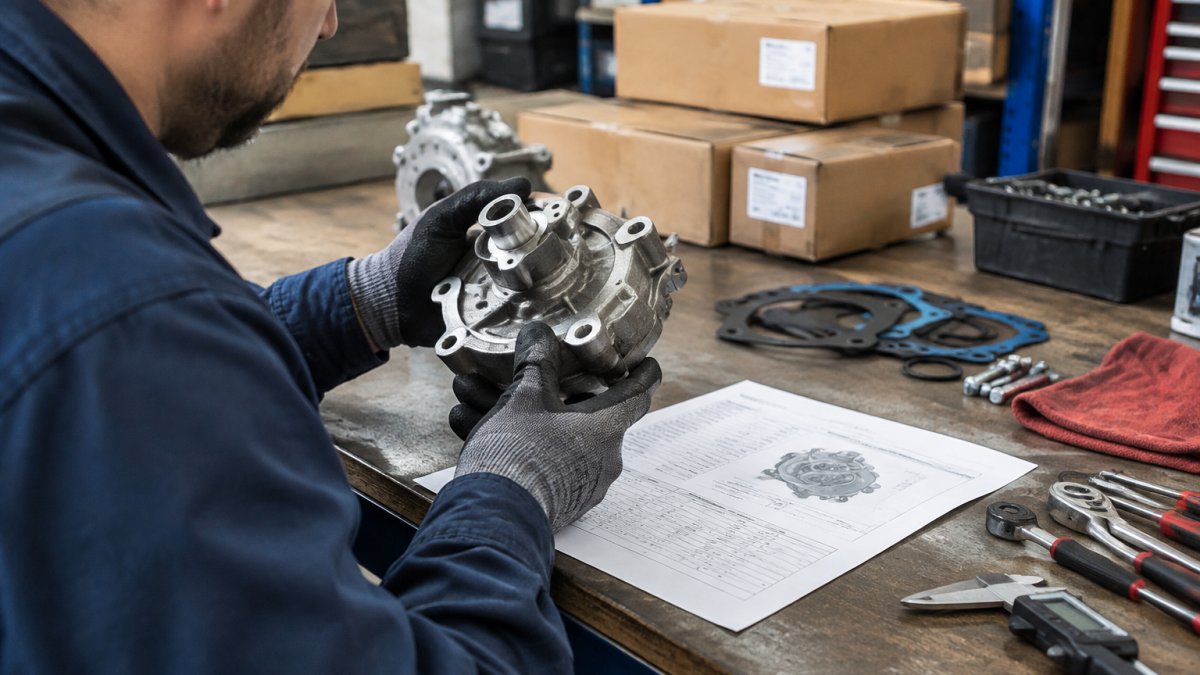
Use this checklist before you order:
- Confirm the exact part number and size
- Check the material and construction spec
- Verify the temperature and pressure ratings
- Confirm the warranty terms
- Ask about return policy if it doesn't fit
Watch out: ordering by photo alone is how people buy the wrong part and waste money. Our guide on how to identify correct equipment parts walks through matching a part to your machine.
At 4J Total Supply, we help customers identify the right part. One customer shared: "I was confused as to what part I needed.
Total Cost of Ownership: The Break-Even Math
Total cost of ownership is the real test of a part's value. A cheaper part that fails twice a year usually costs more than a durable one that lasts.
Add up the full picture:
| Cost Factor | Cheap Part | Industrial-Grade Part |
|---|---|---|
| Purchase price | Lower | Higher |
| Replacements per year | More | Fewer |
| Downtime per failure | Same | Same |
| Labor to swap it | Same | Same |
| Total yearly cost | Often higher | Often lower |
A landscaping crew loses real money when a machine sits idle. The break-even point comes fast once you count downtime and labor.
This is the honest case for paying more up front. It is not about brand names. It is about how many times you have to buy the same part.
Choosing Replacement Parts That Keep Your Crew Running
Choosing replacement parts that keep your crew running means buying for lifespan, not just for today's price. Downtime costs more than the part ever will.
Here is how we would approach it:
- Match the grade to the job. Continuous duty needs industrial-grade parts.
- Check the specs, not the label. Ratings tell the real story.
- Buy from a supplier who helps you pick the right part.
- Keep spares on hand for the parts that fail most.
At 4J Total Supply, we offer a large inventory of industrial parts and equipment. Our team provides guidance in selecting the right parts, and we offer fast service and delivery.
Customers have shared their experience. "Fast service and delivery," one wrote. Another said, "From placing the order to delivery, I am completely satisfied."
The challenge is simple: every hour of downtime costs you money. Get the right parts the first time. Get started with 4J Total Supply and keep your equipment running longer.
Frequently Asked Questions
What is the difference between industrial-grade and consumer-grade parts?
Consumer-grade parts are built to hit a price point and typically carry lighter materials, looser tolerances, and shorter or no warranties. Industrial-grade parts are specified for continuous duty, wider temperature ranges, and resistance to oil, chemicals, and abrasion. A consumer air hose may work fine on a weekend project, while an RMA Class A oil-resistant hose like the OilShield OS3850 is rated for 300 PSI with a 4:1 safety factor and a 3-year warranty. That gap in specification is what separates the two grades.
How do harsh environments affect industrial components?
Heat, cold, oil, chemicals, dust, and vibration all accelerate wear. Thermal cycling expands and contracts materials, which stresses seals and solder joints. Oil and diesel degrade rubber that is not rated for them. Abrasion thins covers and exposes reinforcement. Industrial components in harsh environments are built with nitrile cores, corrosion-resistant brass fittings, and temperature ranges like -30°F to +190°F so those stressors do not shorten service life. Matching the part's rating to your actual conditions matters more than the label on the box.
Why do industrial-grade parts cost more upfront but save money?
The purchase price is only part of the cost. A $19.99 industrial wash-down hose that survives daily cement washdown beats three cheaper hoses that fail each season, once you add labor, shipping, and downtime. The real expense is usually the failure itself, not the part. Track replacement frequency and lost hours per failure to see your own break-even point.
Do electronic components go bad if they sit unused?
They can. The lifespan of electronic components is affected by storage conditions as much as run time. Humidity causes tarnished surfaces and corrosion on leads, and electrolytic capacitors can degrade during long idle periods. Store spares in a cool, dry place, keep them in sealed packaging, and rotate stock so older parts get used first. Check datasheets for shelf life and storage limits. Buying from a supplier that moves inventory quickly reduces the chance you receive parts that have been sitting in a warehouse for years.
